Friday, June 16, 2006

Elitism


Recently I did several things that most people living and working in the city do on a daily basis: eat in a cafeteria and take public transportation. I can hear you saying, "What is the big deal" and seven years ago I would have concurred, but not now. I am just beginning to realize that since completing my residency I have become increasingly isolated. It is as if I joined a private club and no longer need to deal with the rest of the world.

Of course I am exaggerating. Being a lowly Family Practitioner I am hardly in an income bracket that would allow me to completely separate myself from daily chores. I cut the grass, fix the plumbing, sit in the waiting room while my car is repaired and unlike the senior George Bush, know what a grocery check out looks like. But still, I have been afforded a few perks: the doctor's lounge at the hospital and a flexible schedule that allows me to leisurely drive my car to the office.

Most days, for a minimal charge, I sit and eat in a room reserved for physicians. Occasionally there are interlopers, but mostly we gather together and eat. The talk centers on medicine and the food, well most of us would consult our patients against consuming it.

When the lounge was closed temporarily, we were instructed to report to the hospital's cafeteria for lunch. There a long line of employees, many of whom have become my patients over the years, confronted me. I was alarmed at how uncomfortable I felt standing in the long gray coat that is the uniform of an attending physician. Had I become the prima donna we all railed against in medical school. I think not, but still I find just having these thoughts is instructive.

My next foray into the life of the city is on my way to meet my wife and visitors from Kansas City for dinner. Of course it is a Friday afternoon when my car's check engine light comes on. It is not a novel occurrence. Over the years of owning this German car I have learned to ignore the light and its accompanying chime extolling me to perform an "Emissions Workshop".

This afternoon though the light not only appears, but begins flashing in time with the surging of the engine. I pull over, hit the four way flashers and get out the owner’s manual. A reference to the imminent destruction of the catalytic converter jumps out at me, and I begin to plot where to park and how to get a tow while keeping my dinner engagement.

After several confirmatory phone calls, I find myself stepping into a crowded bus. The conveyance is populated with single mothers towing multiple infants and toddlers. A few stops down the road we are boarded by twenty or so well-dressed riotous teenage boys going downtown to the movies. To make matters more interesting a disheveled odiferous young man plants himself very, and I mean very close to me as we all squeeze back into the bus.

Then just when things seem to settle down the bus driver fearlessly barks out a command for the young couple, who boarded during the chaos and slinked to the back without paying, to pay up or get off. At this point in the drama, being fairly close to the elevated train station that is my destination, I bail and walk the rest of the way to the Brown line.

So again I hear you saying, “What is the big deal”. Is he some kind of rube from the country? It is just a bus ride and to that I say, the fact that I am even thinking in these terms is a big deal, at least for me.

Why am I relating this tale to you and what in the world does this have to do with the usual topic of these commentaries, Chanoyu, the Tea Ceremony. Chanoyu in its most traditional setting has a unique feature called the nijiriguchi, the crawling-in entrance. It is a low door that compels all who enter the tearoom to bow low as they enter.

It is a subtle but profound equalizer of people and may be one of the reasons Sen Rikyu, the founder of Chanoyu, was commanded to commit seppuku by Hideyoshi, the ruler of Japan whom he served. The nijiriguchi forced Hideyoshi to humble himself every time Sen Rikyu served him tea and the humility that necessarily accompanies this act is what I feel in danger of losing.

So from now on, as I enter the doctor's lounge, walk into a patient's room or slide quietly into the tearoom I will bow slightly as homage to the nijiriguchi. After all, is that not the whole point of Sen Rikyu’s teaching; to bring the tenets of Chanoyu out of the rarified world of Tea and into every day life.

Wednesday, April 26, 2006

Intensity


Water concentrates energy. Traveling on it requires a level of intensity that is not known on land. It is not a function of speed. Most boats barely approach the trivial mark of 20 mph, but within this matrix enormous variablity exist. It requires fore thought and attention to detail not imagined by most terestrial travellers.

Of course pilots have these same concerns, but amongst the clouds they experience a freedom and lightness that only air can provide. The aqueous environment is more restrictive, requiring lots of horsepower, whether from sails or diesel, to negotiate the medium.

The purveyors of navigational equipment understand the intense nature of traveling by water and provide more and more sophisticated video game like gadgets. Even though it is impossible to keep pace with the technology, these devices are eagerly sought out and installed with the hope of a quick fix for any and all navigational problems.

Today officers on large ships are trained to occasionally look out the window at the real world to see if it matches the virtual one displayed on their flat panel monitors. It is as if the world is flat again and all the work of geographers has been for naught.

But most of the world was discover without sextants or chronometers. Explorers measured the height of the sun to obtain latitude and use it to guide their ships horizontally around the world.

Just as we board aircraft to visit far away places, our counter parts boarded sailing ships. We hear only about the tragedies, but like today’s airline pilots, many square-rigger captains had long careers circling the globe without mishap and any reading of history reveals our founding fathers regularly commuted to Europe on diplomatic or more pointedly, fund raising missions.

To have a hands-on understanding of this go to your main library and check out Captain Cook's log books. Here was a man that not only covered the globe from Australia to the Bering Sea, but was enlightened enough to do it without sacrificing his crew to the common killer of sailors at that time, scurvy.

You can relive his journey through his own hand. He is a succinct writer and a gifted draftsman. His charts and drawings are legendary and in more remote corners of the world, still used.

As Captain Cook brought intensity to his endeavor, intensity brings focus to any activity. Without it to transcend the routine of the everyday world, life becomes commonplace and boring. It is important to understand that intensity is not limited to the special moments in our lives. It can be brought to bear in even the most mundane tasks that have long ago become rout.

I think Chanoyu, the Tea Ceremony, exemplifies this spirit. After all, we learn that the Tea Ceremony is simply hot water for tea. What could simpler, what could be more mundane. But the intensity of study, preparation and practice is transformative. It makes me realize that the simplest task is worthy of all our concentration.

The world is made up of simple acts. The first shovel full of dirt begins a skyscraper. The preparation of canvas starts the process of a great painting. The application of pencil to paper, or maybe today the movement of a mouse, signals the start of a career. Each step informs the process. The smallest detail adds value.

The only down side to intensity is how the world perceives you. Gifted hard-working kids understand this. They are in many cases relentlessly harassed and bullied. Intensity sets them aside from the vast majority of their counterparts.

As I see it there is no need to be put off your game if you are not brilliant. Do not let IQ scores get in your way. Purposeful action combined with even reasonable skill at will get you far. Intensity, persistent, love of life and a curious nature will substitute for innate genius.

Friday, March 24, 2006

Japan Trip 2005


1

Clean, quaint and friendly is my first impression of Japan. It is 4:30 Sunday morning in Kyoto but in reality, at least in my mind, it is still 1:30 Saturday afternoon in Chicago. I am wide-awake, having decided to forego all futile efforts at sleep and write this.

And as if we were home, my mother has most assuredly come and gone from our north-side bungalow after performing her usual Saturday morning ritual of washing, drying and ironing our laundry; a task she has determined is her birth-right to perform and cannot be talked out of. If we were home we would have had lunch and since it is not boating season, be out shopping. But that is not the case this morning, a day later than it should be.

For someone who prides himself on knowing exactly where he is at all moments, I am hopelessly lost. This is the farthest I have ever been from home, some 10,000 nautical miles from O'Hare Airport, and a few obvious truisms, even cliché exist: to get here you have to be packed in like a sardine, without the olive-oil of course and jet lag is exquisitely real. But thanks to my wife Charlotte who took a great interest in our itinerary, I am reasonably sure things will work out.

For some reason after all the years wanting to come to Japan I found I could not focus on the tour books we procured. It had something to do with the names−not being able to pronounce them. I could not distinguish one place from another. I would read about a destination and though my comprehension is quite good, not remember a thing about it let alone the name.

That is not to say I wasn't instrumental in us getting here. Being the president, through no fault of my own, of a group of Japanese and American tea ceremony enthusiast is the main reason we are here in the first place.

Every five years Chado Urasenke Tankokai Chicago Association ventures to Kyoto to commemorate the death of the founder, Sen no Rykyu. This year, 2005, being the 414th year of his death and our 45th year as a group, is the first time I manage to get enough time and more to the point, money to tag along.

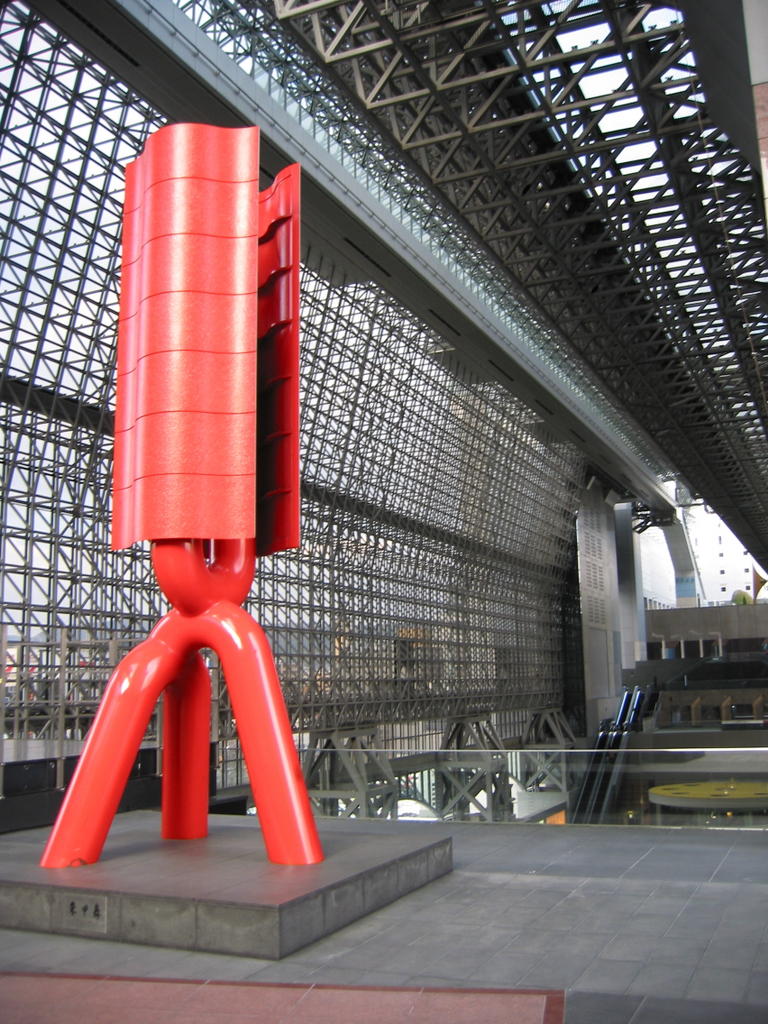
Kyoto is a visually simulating city, an odd mix of concrete and cedar, skyscrapers and sukiya teahouses, dilapidated and pristine. We have churches on every block Japan has ancient temples. These cedar structures have a rich dark patina undoubtedly the result of the acidic nature of the polluted air. Kyoto sits in a basin surrounded by low-slung mountains that occasionally pop into view between the narrow streets and I am afraid that just like Los Angeles and Denver this traps the noxious gases.

Walking through the neighborhoods I see Frank Lloyd Wright's inspiration, I see Florence's narrow lanes with shrines to the Madonna, I see Paris's artisan shop-culture. I do not feel threatened here, but wonder about the need for grates covering windows and secure front gates.

This is a town where you can be confronted with modernity and antiquity within a single step. Coming from the comforting complacency of Chicago's bungalow belt, this town is down right sculptural. Around every corner I see unintended art: a curvaceous jungle gym, a wood and wire scaffold surrounded by discarded tatami mats, round copper down spouts converging into one, elaborate wooden supports lashed to trees to keep them in their place. Each image burns into my mind and on to a memory chip for future reference.

A few days have gone by, most of which I have spent in feudal Japan where royalty never touch the ground except in the chasitsu (tea house) and sit higher than the rest of the rabble. A Japan where water for tea is still drawn from a well and warmed by charcoal, where the kimono is the mandatory dress and life is spent on your knees in elegant small thatched huts.

Of course Charlotte is not interested in kneeling for hours or sitting listening to unintelligible Japanese and thus has made great strides at shopping and familiarizing herself with Kyoto via excellent public transportation. After several days I finally take off my kimono, don a pair of blue jeans and jump on the #9 bus to head downtown to the train station. I get my first big whiff of diesel and feel right back in the 21st century.

Japan, for all its high tech persona, is remarkable quaint. At the Japan Railway (JR) desk three impeccably groomed, identical young women, who speak much better English than they let on, greet us. We are here to turn in our exchange order, validate the JR rail pass that will give us the privilege to ride in the first class green car and to make reservations for our in−country trek.

In America one grumpy clerk pecking away at a keyboard, while tickets shoot out of printer would do this. Efficient, usually−some thing to write about, never. Here in Kyoto there is one lowly computer that nobody refers to and a big book, with well-worn edges, full of maps and tables that is the focus of attention and is used to confirm every transit of our trip.

Suddenly we hear our clerk murmur, "Seems you cannot go this way due to the typhoon”. We look at each other and wonder if our trip of a lifetime is to be ruined and our lives put in danger. Silly us, we were worried about earthquakes and now a big wind is going to get us killed. People at home warned us, but would we listen.

Sensing our growing anxiety she assures us that due to last summer’s storm the tracks are out and disappears through a small corridor for a protracted length of time, finally returning with several small chits that turn out to be our tickets.

But sorry for getting distracted, I was really talking about our rail pass. The cover of this passport-size permit turns out to be an intricately printed and embossed image of Hokusai’s 1833 print “In the Hollow of a Wave Off the Coast at Kanagawa”. I watch with fascination, as the country with the most technologically advanced rail system requires their clerk to sit down and pull over a plastic basket to complete the transaction.

The basket resembles the ones used in Tuscany to collect fresh laid eggs. But unlike Tuscany, this one is full of stamps and inkpads. Five to be exact, the number needed to validate our pass. Each stamp individually adjusted for the appropriate date or number, painstakingly inked and placed in the proper box or on the proper line.

I calculate that at this rate, with a three person staff working from 8AM to 5PM, they will be able to process about 10 clients on a good day. I do not mean to be negative here. Japan runs wonderfully, at least for what we need done, with polite and efficient workers doing their cheerful best within a top-heavy bureaucracy.

Before we use our rail pass we travel with our Tea group on a couple of bus trips. Today Nara is our destination; Uji was yesterday. We are finally out of Kyoto cruising south surrounded by some thing other than apartments, factories and power plants. There are even a few small farms interspersed between the other buildings.

People are out tending their terraced fields. Women in straw hats are sowing seed; working with hoes to cultivate the land and occasionally a small tractor plies the fields. Plots are tiny and the equipment is of similar size−Tonka toy like. It seem impossible that the encroaching sub-divisions and industry will not swallow these postage stamp farms whole, but then Japan will have to import all their food.

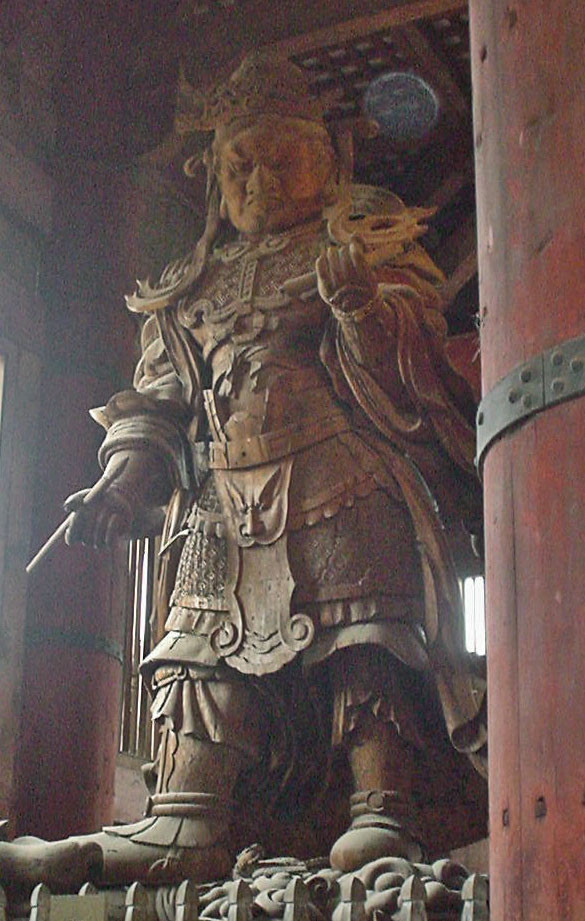
We visit big and bigger Buddha’s until finally coming to the biggest. It looks to be about the size of the moon rocket I saw at Cape Canaveral, only wooden. And just when I start to think not another temple, we drive to a site where Noh is being performed on a stage at the front steps of the magnificently restored temple. I had wanted to see Noh on this trip and stood transfixed as one of our group leans over and whispers in my ear, “very little movement”. And she is right: very little movement, odd beat, all men, nasal mono tone singing, damsels in distress, sculptural kimonos and grand theatre.

Before we saw temples though, we backed into an invisible driveway on a country road and found ourselves in the front yard of the 16th generation chasen (tea whisk) maker’s home. They explain to us that parts of the house are six hundred years old and that the family has always lived here. With the next generation running around, the 15th and 16th generation chasen makers and 16th generation’s wife knelt and created a whisk while explaining all the steps.

They make it look easy, but then every thing everybody does in Japan looks easy. I think this is because their study is earnest and sincere. In twenty years of studying chanoyu I do not even come close to living up to their example.

Friday, the end of our first week in Japan comes quickly and as the bus nears Kyoto after a day of sight seeing, many of our companions begin to leave at various train stations along the way to visit family and friends in other areas of the country. It is sad to say sayonara to my tea friends, they have been wonderful traveling companions. Though most are expatriates, they have a love and a pride in their country that I have seldom seen in other places I have visited.

Chanoyu, the Tea Ceremony, provides a connection to the world they left behind. It provides a connection to the best of Japanese culture. I am surprised that tea culture, at various levels of sophistication, is reflected on almost every street corner, curio shop, train station mall, home, etc., etc. I can see it in the joinery work at the train station platform, in the plastic green ice cream cones in front of the sweet shops, in the conductor bowing as he enters and leaves the train car.

Before I left for Japan my teacher told me that I would come back with a deeper understanding of Japanese culture that would enlighten my study. This seemed obvious at the time, but it is difficult to put into words the profound effect it has had on me.

Simply, it is similar to when I first practiced chanoyu with kimono. Before I had ever worn kimono I just went through the motions that had been prescribed for me and afterward, well it all just made sense and the movements became instinctual, allowing the intellect to concentrate on other aspects of tea.

2

We finally get on our own and head for Koya-san. This we do with mixed emotions. While traveling with the group we felt in a cocoon, protected and looked after by our friends, but now we will have to face Japan and deal first hand with our lack of language skills.

Koya-san has a spectacularly eerie mountaintop cemetery with over 250,000 ancient and modern souls buried within a native forest of towering cedars. Dark, damp, lichen and moss covered with a hint of cedar and pine in the air, until the odor of incense points to the existence of the Buddhist temple at the end of the trail. Unfortunately we could not linger, we needed to hurry back through the forest due to dinner at the Buddhist Monastery, where we are staying, being served at six.

The next day after a night spent on the cold mountaintop our brains are muddled with blurry vision, stiff backs, sore muscles and indigestion running a close second. Koya-san did it and the Buddhist Monastery where we ate, slept and prayed at didn't help either.

The Buddhist temple takes in guests like the convents in Italy that provide shelter for the faithful on pilgrimage. It is a pilgrimage to get here. Four inner city trains, a cable car and two buses are negotiated to get to the top Mt. Koya.

All this train taking makes me realize that in Japan you do not just wait for a train, you find the specific sign for your train and car amongst all the other signs for all the other trains that will ever or have ever stopped at the station. Of course this takes entering into five conversations with various officials and unlucky by-standers before you are in queue at the proper place. And I mean in queue.

There is a protocol for when you can be pushy and barge on to a train and when you just get in line and wait. Any train with seats that sit fore and aft−be polite, any train where you sit facing each other−feel free to push and shove. But I admit, even in central Tokyo at the height of rush hour there is not a lot of bad behavior, crowding yes, but people still maintain a high level of civility.

I could not help notice the many commuters sleeping on trains; heads slumped on to the shoulders of their seatmates. You'd think you were in Italy where no one eats dinner until 11 at night, but then again no one is sleeping on trains in Italy lest hoodlums carry you and your loved ones away, but as far as I can tell no one is being hijacked here. More likely it is due to sleeping on tatami mats that has made this a country of insomniacs, only able to catch up on their sleep in public.

Next we move on to Kanazawa, an industrious looking city on the western border of Japan not far from the coast. The city has a strong history of tea and the making of tea utensils. When Charlotte put this on our schedule we had no idea that one of the Gyotei-sensei (professor) who was my teacher during our stay in Kyoto is the second son of a famous family of ceramist.

His family apprenticed with the 4th Raku generation and moved to Kanazawa in the 1600's to make tea utensils for the Shogun. The tenth generation of the family is still making exquisite ceramics and of course tea ware. Their trademark is a rich amber glaze call ame-gusuri.

During my teaching session in Kyoto, sensei asked where else I would go in Japan. When I replied Kanazawa he invited us to visit Ohi pottery to see the museum of his family’s pottery. I was to call when getting to town. I did, but unfortunately he was leaving to go back to teach in Kyoto Sunday night. He asked us to come to the museum for a visit anyway; his family would be there to greet us.

We arrived after spending a cold morning wandering around town. First we went to the Kenrokuen Tea garden that, well I am not exactly sure how to describe the breath of the garden with every leaf in place, every 400 year old tree’s limb supported by a complicated web of lashed on poles, the first fountain built in Japan and on and on.

Second we went to the market; all kinds of weird expensive seafood and thirty dollar melons. Third, a sweet shop that made sweets before there was sugar in Japan. Fourth and fifth and who can remember, but the Ohi family I will not forget.

After the usual confusion due to, what I like to call the Tower of Babel syndrome, we were shown to the museum and set free to wander on the three floors of mainly tea bowls dating from before our country was founded and a few other art objects. Once finished and not knowing what else to do, we returned to the front desk and were lead into the family’s tearoom for a sweet and a bowl of matcha (thin green tea).

There my teacher’s wife and his mother met us. While his wife made us feel welcomed and described the various treasures, his mother stood and stepped out for a moment. She returned a grand mother carrying our teachers beautiful plump six months old with jet-black hair standing straight up. This baby girl put all the other artwork to shame.

As you probably know by now if you have been reading my previous stories, you always have a sweet before having matcha. We had heard legend of the sweets in Kanazawa and then one suddenly appeared before us.

How do I describe this golf ball size morsel? It almost looks like a hollowed out gourd except maybe it is wrapped in some type of pastry or maybe a little basket or eggshell topped with tri-color ribbons. I would need to attend the Iowa City Writer’s Workshop to do this one little sweet’s description justice.

But let me continue as best I may. When you eat a moist tea sweet you divide it into three pieces with a small pick that is usually provided. I use a little metal pick I keep stashed in my kaishi. Kaishi are checkbook size folded stacks of thick white paper that are used to place sweets on and for general clean up purposes during tea.

Matcha was brought and served to us by sensei's wife. The chawan I drink from was made by the father of the present generation. It was black similar to raku bowls but was made in the style of Korean bowls with a wide mouth that narrows down to a tallish unglazed base.

The second chawan that Charlotte receives her tea in was more traditional, with a wide mouth and straight sides resting on a short stand. It has Ohi pottery’s signature amber glaze with circular curlicues shapes pressed into the bowls side.

The chawan, their hospitality and that baby girl are priceless memories. To be honored as such is truly the meaning of ichigo, ichie−one meeting, one time.

3

Off to the mountains again, Takayama is our destination today. I wait, camera in hand as the train pulls into the station, but this train does not look like the usual bullet train. Our reservation is for car #2 and sure enough the second car's entrance stops right at the allotted spot, so we instinctively board.

Please let me explain some thing here. When you arrive on the platform to board your train the work has just begun. Maybe this seems odd to me because as a nation we are not typically long distance train riders. We are in our cars or on planes or in cars driving to planes.

In Japanese train stations there are multitudes of signs specifying where trains and their cars will stop on the platform i.e., Train A /Car 1, Train A/Car 2. Given that the train stops for one minute and 8 second (believe me I timed it) at each stop, it is imperative that you be in the exact place to board, in queue of course.

The only people exempted from this standard practice are the ninety-pound, unmarried, twenty something females known in Japan as “parasites” for their proclivity at living off their parents. Highly coiffured with six-inch heels they prance to the front of the line, into the train like a gaggle of geese and drone on until finally exiting with a flair.

The signs are mainly in Japanese characters except for a few of the more modern stations that service the shinkansen, otherwise known as bullet trains. We have become adept at recognizing the shapes of the characters, but not their meaning and can usually find the proper place to board.

I find odd my sincere need to acknowledge every Westerner I see. In Chicago I can go months without ever looking up, but here there is an instant bond between travelers. Of course, you can tell the long time Western residents. They will never signal back, having I am sure with much effort, habituated themselves to the environment. Reminds me of waving to other VW Beetle drivers in the 1970’s when the car made its first appearance in the USA.

The other odd thing is this train of ours, the train that is to take us into the mountains, is spewing diesel from the top of each car. Seems down right primitive compared to the sleek electric trains we have been on, but once inside it is redeemably plush.

We settle in, the train starts to roll and it is then we realize we are facing backward. A bit disorienting especially as the train picks up speed. Our initial response is to turn the seats around to face forward. Turn the seats around you say? Earlier in the day when our train pulled into the station one way and left another, the entire car stood up and immediately rotated their seats in the right direction to face forward−lock step.

So now on this train, we stand up and rotate our seat, but notice everyone else is sitting drinking beer and eating lunch out of bento boxes. Maybe they know something we do not, which of course they do. At the next stop the train takes off in the opposite way and we are facing forward. No need for motion sickness bags on this leg.

Morning and breakfast come early in Takayama. Our meal is served on wooden trays with no less than thirteen different dishes used to present the various types of tofu, pickles, fish, roots, seaweed, broths, not to mention the prerequisite runny eggs, rice and yogurt with strawberry. Add these dishes to the plates used during dinner and we are probably up to thirty unique pieces of ceramics. Where do they store all this stuff in these tiny homes?

We walk up to the Old World Wisconsin of Japan to view rustic homes gathered from all over Japan−we should have taken the bus. We walk up to the ruins of a castle−we should have taken the bus. We take the bus down to the historic center of town−we should have walked.

The town lies in a basin between two high hills and it has retained its agrarian roots. Walking from store front to store front we are drawn on by the smell emanating from sake and miso brewers and by the artisans making everything from paper to dolls to fine lacquered pieces.

Takayama, the little mountain village is not really a village, it has grown up. We are in the old section of town, staying in a pricey ryokan (don't pronounce the “r”) otherwise known as a Japanese Inn. Think bed & breakfast with dinner, tatami mats and your own server. As every thing takes place in your room, someone is needed to rearrange the furniture every morning and night.

The fourth night on our own I reach my limit of raw fish. Well not just raw fish, but raw any thing that ever swam in the ocean or scurried on the ocean floor. Charlotte, a real trooper up to now, finally balked at the raw octopus with half its head, brains and all beautifully arranged in a fashion that only a Japanese chef can. We requested no raw fish for our next dinner and a Western breakfast due to our confrontation with the little creature. It packed a visual punch.

After two days, we board the train in Takayama and proceed to wind down the river valley toward the sea. Today it’s Tokyo or bust. Up in the mountains it is cold and rainy with the clouds obscuring our last views of the mountain scenery, but I imagine the weather will be different down on the coast and it turns out to be warm and sunny.

The Japan that I am seeing race by my window is a megalopolis. Just when I think there will be some wide-open spaces, the train comes out of a tunnel and there is another city. Of course I am talking with limited geographical knowledge, but in the onsen (hot tub or hot spring) a trekker from Montreal confided in me his disappointment with the wide gap between his image of an ideal Japanese landscape and its reality.

While we trekked around the outskirts of Takayama we saw great snowy peaks off in the distance and even warnings of bear. I imagine if one showed its face some one would figure out how to serve up the various parts, except maybe the teeth, claws and bone, for dinner and snacks with beer. Nature seems far removed, but the splendor of Japan lies in the small touches.

Traditional homes amongst the concrete, the container gardens sprouting from the stair steps of every home, the manicured pine and cedar trees reaching out from behind small walled-in compounds, the care with which every plate of food is arranged and served and for that matter the care with which every cash transaction takes place, the exotic to sublime flower arrangements in store windows and in all the small street side shrines so tenderly cared for.

These touches and the genuine congeniality of the Japanese people more than make up for the urban sprawl. I have traveled a bit and the Japanese rival the Irish for their gentle, endearing nature except it is present in a formal sense. By this I do not mean stuffy, but like the tea ceremony, it is codified and offered with the heart.

I sit on tatami writing this, looking out through windows placed at eye level in the shoji screens that line our space, viewing our room’s small gardens on either side, listening to water flowing into moss covered stone fountains from bamboo pipes.

The gardens are still secured for winter. The trees are fastened to stakes with handmade straw ropes; pine boughs are intertwined to provide some color and texture. This is presented on a ground of bark and bamboo fences, opaque to the outside world.

This is a world unto itself. It gives me an idea of just how isolated you can get in your little or large, depending on the size of your check book, compound. I feel comfortable here because it feels like I am in a boat.

A boat confines, but also offers the possibility of a wider world, a direct experience with nature. This room does the same, except offers a direct experience to an inner world that is just as expansive, if not more so and without the worry of the anchor dragging.

We have traveled a couple of hundred miles from Japan’s Alps to Tokyo and as we approach the capital of Japan, the coast becomes a perpetual city. Of course this is all I see from the train and each train we have taken, starting with the cable car at Koya-san, gets faster and faster.

Our train into Tokyo is not the fastest and it makes a few stops along the way, but on the last leg of our journey it picks up speed until I am feeling uneasy. As we accelerate, the tailored gentleman seated in front of me leans over his wife to shut the window curtain and I hear Mozart coming from his earphones.

This may help him alleviate the stress of traveling at these speeds while still on terra firma, but I find it hard not to stare out the window. I marvel at how much real estate is passing by and cannot stop looking even if it is unsettling.

Tokyo turns out to be a safe well-run city. We camp in a 5-star hotel overlooking the Imperial Palace and decompress for several days. My nephew Nick, who has been teaching English to the youth of Japan for a year in a half, shepherds us around.

We finally catch up with the elusive cherry blossoms and rub noses with the crowds that they attract. The white blossoms remind me of the last snowfall in spring; big fluffy flakes that disappear quickly into the warming soil.

Now I am sitting in a vehicle moving at three times the speed of the shinkansen, burning kerosene instead of electricity from a fast breeder reactor. We are over Montana dropping down into Chicago’s airspace and having fitfully slept across the Pacific Ocean I have the illusion of feeling refreshed.

Some trips are fun, some stressful, some life altering. This was all three, though in my present state of jet induced fog I doubt I can do justice to the task of recounting why.

Kyoto and tea culture, sumi (charcoal) warming mizu (water), potters and chasen (tea whisk) makers, four hundred year old chawan (tea bowl), industrial tea processing, one hundred foot tall Buddha, eight-course tofu dinner, the delight of friends, wearing kimono for days at a time in rain or shine, delivering a speech and a toast, living on tatami for a week, temple vegetarian cooking, fresh beer poured well, tiny purple raw squid that kept appearing at every meal and bowing, bowing, bowing. It was a real joy to spend two weeks with such gracious people.
Tuesday, January 24, 2006

Spirits


Japan is a country of spirits. I saw them everywhere: in temples, in homes and small street-side shrines, even in the guise of little cartoon-like creatures that are so pervasive. Though I have immersed myself in Japanese culture since a teenager, I do not think I would have come away with this feeling had I not lately traveled to Japan.

What differentiates spirits in the West from spirits in Japan is that most Westerners considered spirits malevolent. They are the things that go bump in the night and we are taught very early on in life, to run from them. As far as I can tell, even horrific demons in the East receive respect.

This recently came to mind while watching Miyazaki's Spirited Away. I sat in amazement at how a cute little girl bowed to one monster after another while I recoiled in fright. She refused to be intimidated and carried on with her mission.

There is a spirit in Japan, for lack of a better word, that I could not quite grasp. I felt it in my soul, but not in words; it is another world, an under current in the general culture. Not hidden like the occult in the West, but exposed. A part of the Japanese soul that is visible for all to see. The spirits live comfortably, just part of everyday life, as members of the family.

In the West our relationships with spirits are on more formal terms. Just think of the biennial sightings of the Virgin Mary in Chicago, once discovered the images are treated with a mixture of awe and disbelief. Communing with spirits is extraordinary here rather than ordinary.

That said my mother-in-law, Tillie, has recounted stories of a friendly ghost that resided in her house as a little girl growing up in Sumter, South Carolina. This being was just there, walking the halls and is spoken fondly of, as if it were the family cat coming and going as it pleased.

The veneer of Western civilization slowly lifted during my two weeks traveling in Japan. l began to see, maybe sense is a better word, layer upon layer of culture. This is palpable for me. I do not have to intellectualize it. In 1973 after vowing not to return to college until I acquired the basic skills of reading, writing and arithmetic, I spent six months in another ancient land with the trappings of the West obscuring the underlying culture.

Traveling the length and breath of Israel, from the Golan Heights to Ras Muhammed at the tip of the Sinai Peninsula, I sensed the presence of spirits. Once in Jerusalem at the Wailing Wall I walked into a passage surrounded by Orthodox Jews bedeck in tefillin, bowing back and forth as they offered up their Sabbath prayer.

As I made my way through this morass, feeling out of place amongst the faithful, I peered down a meter-square floodlit hole excavated in the temple floor, at artifacts crushed into thin layers like a fine Bavarian tort. The strong light faded before the bottom was revealed, but even then I appreciated that this represented ages and ages of the previous inhabitant's life work, now reduced to dust.

The layered deposits remind me of my first view of the Grand Canyon from Mather Point. Gazing across the canyon at the strata exposed by the cutting action of the Colorado River on the slowly rising land, I find myself awe struck. In Jerusalem the layers represent a continuum of thousands of years of civilization, in the Grand Canyon millions of years of nature.

Though most of the historic and geologic details are lost on me, this heritage is an intrinsic part of each and every person in the East. The knowledge, though not schooled in many cases, is a very comfortable part of every day existence in the Middle East and Japan.

I make a mistake by separating culture and nature. This is why, despite all my study, spirits do not come easily to me. Ideally Japan commingles its spiritual life with it intellect. Maybe this is the answer to my question why spirits are embraced in Japan rather than exorcized.

Before I landed, after ten hours traveling East across the Pacific, plans for a return trip were forming in my mind. The desire to immerse my soul and intellect in Japan is driven by my need to translate feelings into words.

Sunday, January 08, 2006

Frugality


In over twenty years of participating in Chanoyu, the Tea Ceremony, I have had the pleasure of meeting many inspirational people. Amongst the most memorable was Minnie Kubose. Minnie Kubose devoted her life to her students, to her study and to the teaching of Chado, the Way of Tea.

If it were not such a cliché I would say she and her husband, Rev. Kubose, lived like church mice. Sitting in their kitchen I noticed how every morsel of food was savored. The most telling was how the overcooked rice on the bottom of the pan was cherished and saved for the next meal. It occurs to me this may be the Japanese equivalent of cracklings.

For my generation, who grew up with an abundance of food and some extra income to “feed” as the initiation of fast food took hold of the country, this frugality is hard to fathom. Thinking in terms of today, where much of the population is so bloated with junk food that we were forced to purchase a larger scale in my office to accommodate them, it becomes even more implausible.

Growing up in my house the battle cry at each meal was waste not - want not. If that plea went unheeded and the vegetable-du-jour was left uneaten, the less fortunate children of China were invoked to help guilt me into compliance. It seldom worked. I had trouble understanding frugality until I matured and began to realize the sacrifices my parents made to provide me with such a larder.

They had been born in America to parents displaced from Italy due to the deep-seated cycle of war and poverty. Though they would never admit to poverty, their lifestyle reflected their experience as children during the depression, as adults helping win WW II and later working in demanding low-paying industrial jobs.

I wrongly confused their frugality as stinginess. I now understand it stemmed from a respect for hard work and the privileges it provided us. Waste was unacceptable for them considering the long hours they spent laboring.

The concept of frugality presupposes respect for an individuals work. It could be the creation of fine art or the sowing and harvesting of rice. It is the notion that every grain of rice grown should be considered a miracle. That the carbon, hydrogen and oxygen, along with the trace elements that make up this complex carbohydrate, gives each grain its own distinct identity and taste.

To get very far a field, all the constituents of rice are derived from cosmic dust, as are we. What could be weirder or more wondrous to contemplate than that? I think this is the wider meaning of phrases like universe in a grain of sand or on the head of a pin. Each structure, no matter how inconsequential, contains within it the elemental nature of the universe just waiting to be unlocked.

Natural beings are the epitome of frugality. As I sit and watch the goings on around my bird feeder this becomes apparent. It is filled with tiny thistle seed to help keep squirrels and larger birds away, but nonetheless the feeder collects a menagerie of critters. Sleek gold finches and matronly house finches scuffle to find a perch, while dark-eyed juncos and mourning doves show more cooperation feeding on the tailings from above.

All this activity unfortunately attracts the sinister black cat from across the alley. Despite our best efforts to dissuade this pest from our garden, a lawn full of feathers greets us several times a year.

We have tried wire fences, noxious chemicals, high powered water guns that have more in common with military assault rifles than squirt guns and contemplated murder in darker moments. But nature exploits every niche and sees to it that nothing goes to waste. I realize this is the natural order even if the drama played out in my backyard is by a well-fed cat.

So where am I going with this notion of frugality. Nature itself turns out to be the ultimate miser: the laws of thermo-dynamic state that matter cannot be created or destroyed but only transformed, Einstein’s equation E=mc2 defines an unimaginable economy, high-energy particle physics demonstrates the infinitesimal character of every particle of dust.

Japanese Tea culture instinctively came to understand these fundamental truths. Sen no Rikyu, the founder of the tea ceremony in the 16th century, changed Chanoyu from an ostentatious pursuit to the personification of frugality. Tea bowls molded of rough clay, huts constructed of straw, mud and reeds, ladles and scoops fashioned from strips of bamboo; the irony is that frugality is taken and turned into treasure.

Saturday, November 19, 2005

Wavelets


A boat is an outstanding place to ponder, at least when not crouching in the bilge covered in oil. It is my idea of an artist colony for one. Similar to institutions that sponsor artists in stately old mansions high in the mountains or in the flinty woods of the northeast, allowing them pursue their work isolated from life’s mundane tasks.

Of course, on the boat I have provided myself with a grant to sit and look out of the pilothouse. No one has to recognize my talent, and I do not have to submit a portfolio for anonymous judges to review. Just sitting and looking is my preoccupation, and while on the water simple things become important. Things like the surface of the water.

Nestled in the harbor wavelets predominate my visual field. The lake requires attention to Mother Nature: wind, water, clouds and waves. It requires all my concentration for navigation and for monitoring the fickle weather. These tasks become the preoccupation when underway. There is seldom time for contemplation.

The harbor relieves me of such duties and allows me to think about smaller, dare I say more inconsequential details. A harbor is a refuge that tempers the weather and lulls us into complacency. This is lost on many new boaters, drawing them out into uncomfortable, even dangerous encounters with the lake.

In my early days of boating and occasionally even now, when passing the red and green towers demarcating the harbor from the lake; if the weather is foul a sick feeling in my gut brings the realization that I should have never ventured out in the first place. And to make matters worst, once out it can take an agonizingly long time to get safely back and snug in your slip. Believe me when I say this, it is from hard won experience.

My point here is the minutiae of every day life, the things that make up the environment we become habituated to. As I sit, absorbed in the scene at the end of a long boating season, the surface of the water is disturbed by steady droplets of rain, by diving gulls, alighting Canadian geese and preening mallards, and by the death throws of the last few remaining salmon.

Wavelets radiate out from the nidus of raindrops in two groups of perfect concentric circles. The circles interact with the other ringlets created by the chilling October rain and intersect with waves generated from strong northeast winds and from the wakes of the few craft that still reluctantly ply the increasingly cold water.

The infinite variation, mind boggling as it is, follows physical principle and I am sure a physics professor has written equations to explain the phenomena. For me the changing nature of the universe is reflected on the surface of the water. It makes plausible the cliché that monarchs flapping their wings in the Yucatan can change the path of a hurricane.

Because of my interest in Japanese culture, especially chanoyu the tea ceremony, I take for granted that all this detail is not to be taken for granted. Nothing is as simple as it appears and everyday, even every second, is our last never to be repeated.

If it were a bright and sunny day my musings would take on a different tone. But today with winter, and the isolation that it brings not far away, these ponderings open up a rich world of experience that is always at our backdoor, but usually ignored in favor of images provided by the travel channel.

It makes searching for paradise in far-flung places unnecessary and relieves me of the burden of expectations. Things are just what they are…glorious, whether sitting in the pilothouse on a cold raining fall day, shoveling snow in my alley on Talman Avenue or walking amongst the graves under a canopy of ancient cedars on Mt. Koya-san.

Thursday, November 10, 2005

Aimlessness


The first task of the day, after a cup of cappuccino, is to round on patients in the hospital. For those of you who have ever had the misfortune of being in the hospital, whether as a patient or as a practitioner of the art of medicine, you know the seeming aimlessness of much that goes on within the confines.

Having worked and studied in many institutions over decades of training and practice, I still find myself in awe of the shear mindlessness of much that goes on. I chalk it up to corporate culture, each hospital steeped in its own tradition, carries on in its own way.

But I digress, in medical circles the students term for aimlessness is "scut work". Examples being never-ending histories and physicals, interminable note writing, fetching any thing from Swans-Granz catheters to donuts and coffee and the most annoying of all, didactic education in the form of morning report and lectures given throughout a day that is already seriously overbooked.

Years ago I read a famous book called Zen and the Art of Archery by Eugen Herrigel. This book, as I remember it, is basically a thesis on scut work and how the protagonist anguishes over the difference between his idealized concept of the teacher/master and the realities of his apprenticeship. There is much second-guessing by the main character that, without giving away too much of the story jeopardizes his relationship with his teacher.

The narrative is centered on his perceived privilege as a student. In medicine and I think in the Japanese sense of education, respect and privilege are reserved for teachers and earned by students. This contributes a vital link to the training process, producing confident, mature professionals that will some day replace their mentors.

Aimlessness is a fallacy for any serious student and thus the reason it is fought against so rigorously. But aimlessness, at least the way I think of it, is what teachers strive for. It is similar to the aphorism, knowledge for knowledge’s sake. I think of it as a koan: the more an idea is concentrated on, the less chance there is it of ever being understood; the less effort given to solving it, the more futile the attempt.

We have all spent hours, even days, memorizing our notes and taking exams, but as the hours pass it is difficult to remember what was so judiciously studied. Facts are memorized and forgotten, but concepts are absorbed and it is in this that aimlessness is invaluable.

In Chanoyu, the tea ceremony, there is a place, and I think an idea, called mizuya. It translates as kitchen or maybe pantry. It is the physical space where various utensils, and oneself, are readied for the preparation of tea.

For initiates and advanced students of tea much time is spent in the mizuya. The Thirteenth Grand Tea Master, Ennosai, wrote that the mizuya is the training ground for the tearoom. It was here engrossed in mundane tasks similar, in spirit; to the scut work performed by medical students that chado (the Way of Tea) began to infuse into my soul.

Students need to put time in, doing whatever work their teacher deems necessary. Of course there is no reason not to gripe. It is a fine tradition to be shared with your colleagues as long as you remember that the educational process, however chaotic, has been honed over hundreds of years and is probably the same training that your mentor endured and complained about.

It is the need to master commonplace tasks that makes chanoyu and medicine so hard to pass on superficially. Short cuts leave both student and teacher unfulfilled. The vast under estimation of just how much “blood, sweat and tears” goes into either pursuit is one of the main reasons that chanoyu and pre-med have such high attrition rates.

But one day if you persevere with your study, as you enter the mizuya the fragrance of damp cedar, bamboo and linen will become evident, it is a fragrance so infused into our minds that we would sense it even if it were not there. Once preparations are complete, tea is made and served as the earth takes another aimless spin around its axis.

Monday, September 26, 2005

White Noise


I write this sitting on the deck of my boat at the entrance of Montrose Harbor. It is a warm Sunday afternoon in August and I am trying to read. Out here in the sun there is a constant stream of watercraft passing before me, creating a monotonous din similar to the black boxes you can buy that produce white noise to help lull you to sleep.

As the day goes by transitioning through twilight and finally night, the boats are tucked into their slips, the boaters depart for where about unknown, the police chase the hangers-on out of the park and the sound of cars on Lake Shore Drive surface to replace the din of the passing vessels at the harbor mouth. It may be blasphemous to say, but noise emanating from the speeding vehicles on LSD is a good imitation of surf breaking against the pristine shores of Florida’s Panhandle or the barrier islands of the Carolina's.

During my recent trip to Japan I noted that the country is immersed in white noise. From the tinkling fountains just outside our room in the ryokan’s (traditional Japanese inn) we stayed in to the water streaming past every door in the quaint mountain town of Takayama or the rushing streams coursing through the metropolis of Kanasawa. There is some thing comforting and oddly motivating in the constant flow of cold mountain water in Japan’s cities and countryside as it searches for its final destination in the sea.

And the one thing I am most familiar with about Japan, chanoyu, the tea ceremony, has a multitude of sources for white noise. The sound present from numerous objects used during the preparation of tea: some natural, others man-made. I even think the faint hint of incense that lingers in the tearoom synergistically fosters the calming effect that white noise tends to produce.

There are several different schools of chanoyu and the Urasenke tradition, of which I am a member, has the largest presence outside of Japan. We visited the headquarters this year and took instruction in tea for two mornings from several gyotei sensei (professors). To better accommodate us, our group of thirty teachers and students is split into beginning and advance groups. The sessions are held in tearooms located in Urasenke's 400-year-old compound in Kyoto.

After being introduced to our instructors a short orientation is given and I settle in with my small class. I kneel as best I can in the tearoom listening intently and watching my fellow students perform the specific teas that were assigned to them. Though unable to see through the shoji screen walls, we are surrounded by an ancient manicured garden and the sounds of the garden, and the nature they represent, begin to filter in to my consciousness.

The quiet cacophony distracts me and I find it hard to concentrate on the lesson at hand, but I am not sure anyone else in the room notices my inattention or the sounds of the out side world. Voices identify themselves: birds, squirrels, insects and the rustling of the leaves from a warming spring breeze.

I am hearing, as water pours from the ladle into the chawan to start the purification process that begins the tea ceremony, a life and death drama begin and play out. A struggle between the magnificent crows that are ever-present in Japan and a mother squirrel protecting her off spring.

As I listen, matcha is whisked into hot water, placed on the tatami mat before a beautifully kimono-clad student and I have one of those full circle moments. Here, surrounded by the ultimate expression of human culture and sophistication, while just a breath away through paper-thin walls, nature in a raw expression of survival is playing out.

At that moment, as if on cue, the teacher abruptly slides the shoji screen open and the outside world rushes in. At once breaking the spell the sound has had on me and at the same time confirming my thoughts that we are rooted in the natural world and that for all our sophistication, we are not separate from nature and its consequences.

Wednesday, August 31, 2005

Words


Words come in many guises. They exist in a multitude of divergent images. Ancient cuneiform clay tablets and pixilated computer screens compete for our attention. But I am not concerned with grammar or meaning, more with symbols.

Oriental script is distilled pictographs, fractionated images from life. The first inkling of words I imagine as cave drawings that quickly became stylized. Our ancestor’s images and thus their thoughts are apparent. Images of their hands, the animal they hunt, their weapons and the gods they worship repeatedly appear. But when it comes to kanji, the Chinese alphabet, I find any attempt to casually decipher the characters futile.

I have recently tried to understand the different genre of Japanese script. Many years ago a friend, who spent half of the 80's teaching English in Japan and Korea and in the process became fluent in both languages, took an ad from a Japanese magazine and dissected it for me.

The complexity of the ad overwhelms me: hiragana, katakana, kanji and English are all combined to produce a visually stunning ad. We use many fonts in English, but a common script, whereas in Japan you are dealing with multiple alphabets.

While attending Southern Illinois University in the 1970's I became friends with a young women from Oman. She was working on a second master’s degree, this time in mathematics, trying to stave off an inevitable arranged marriage to her cousin.

In describing her path to SIU she related the political Diaspora her family traveled as they moved from Madagascar to India, finally settling in Oman. During her journey she learned French, English, Arabic and a smattering of other languages. I was very envious of her linguistic skills till one day she confided in me her difficulties forming thoughts.

I could not image why, she was very articulate. But to her, the lack of mastery of any one language confused her thoughts. She did not know what language to think in. Each language presented her with a different worldview.

Thoughts are made up of vocabulary, a lexicon of words and symbols. Which brings me back to cave drawings. How different our worldview would be if our alphabet were one of images as opposed to a series of straight and curved lines. It is the difference between Descartes and Gautama Buddha, between symphonic form and the ragas of India.

Perception within the same language is dicey; think of the bible or the constitution. Interpretations are constantly in flux. Now imagine transferring information between the east and the west. Many of us have experienced the translation of one kanji that can continue on for minutes to hours.

I regret my lack of language skills. I do not know if it is laziness or a lack of IQ, but I seem doomed to experiencing a culture without the ultimate inclusion of words. It separates me from the culture, but I try not to concern myself with this perceived deficit. The aphorism, one meeting/one time, behooves me to make the best of every moment. Life happens once, second by second. I do my best my best with the knowledge and skills I have and get on with the art of living.

We see, interpret and describe, reforming words as need be. Words are used to delve into the minds of the great apes. Once we have a common alphabet, composed of both words and images, it opens up their world to ours or maybe visa-versa. The popular press was shocked at how much humans and the great apes have in common. This use of words forced a reevaluation of the ethics involved with our interaction with these animals.

In a way, our Western language is once removed from the objects we describe. I think of the structure of DNA and wonder if the image of a double helix was known to the ancient Chinese what the kanji would look like. By the time we have a word we are several steps remove from the actual object. Somehow kanji seem more direct and thus contain more information, information that leads to speculation, interpretation and thought.

I will always cherish the memory of the pondering I naively initiated between Rev. and Minnie Kubose (my tea teacher) by simply asking what the scroll hanging in the tokonoma meant. The unintended consequence of which was I got to rest my knees for the twenty or so minutes it took to come to the conclusion that it would take another hour to really do justice to the topic.

So what is my point, for once I am not sure. I think I will just end with 言 (gen).

Tuesday, August 02, 2005

Ambiguity


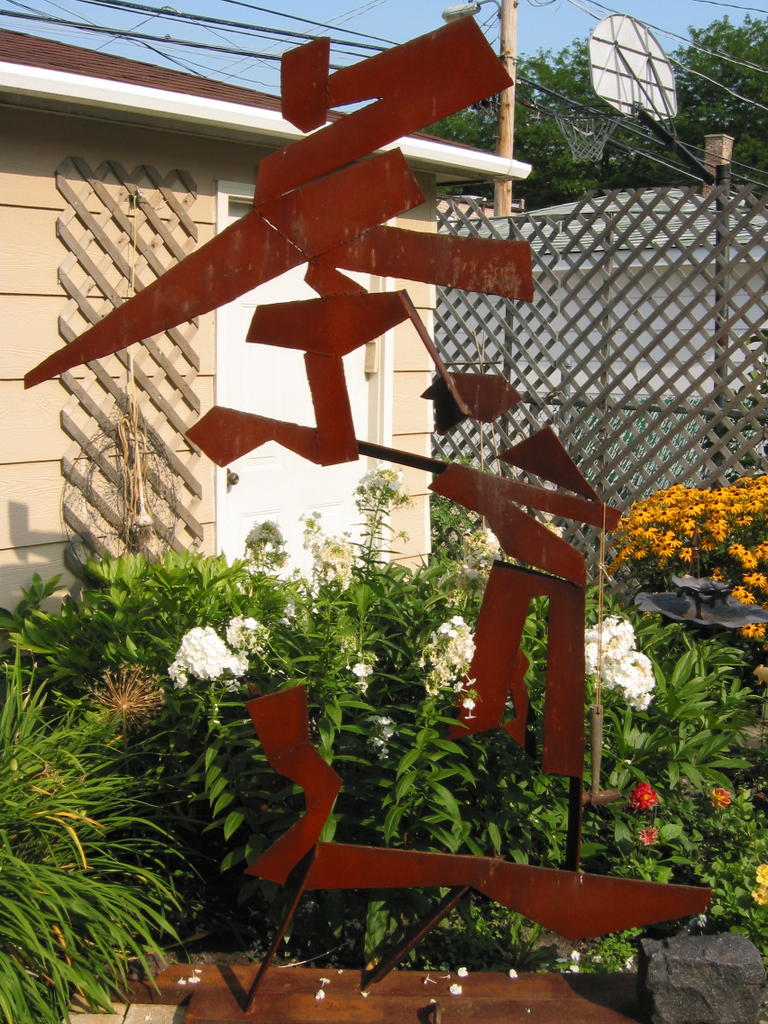
One thing that fine art has in common is ambiguity. I cannot take credit for this idea. My teacher Darrin Hallowell, a fine sculptor, made this comment when looking at one of my little creations. We were discussing my latest sculpture at our end-of-semester critiquing session. I do not suppose that my art is fine but only comment how the work has evolved over the three years I have been taking his metal sculpture class at the Evanston Art Center.

I added a small detail to the edge of the base, an uncommon gesture in my pieces thus far. This seemingly insignificant addition, a small piece of scrap steel cut from another sculpture, drastically changed everyone’s impression of the work. #24 is the name of the sculpture, the twenty-fourth effort of my short career.

The addition changed the perspective, the form and how the eye relates to the structure. In other words, the whole is suddenly more than the sum of its parts. This is what ambiguity is all about. It is the itch you cannot scratch. Why this is so, well that is the question, isn't it?

Living in Chicago affords the opportunity to exercise one’s aesthetic sense. Every day on the commute home, while creeping in traffic, I look up to see Buckingham fountain and the skyline looming behind and think, what a wonderful place to be trapped. The majesty and power of the fountain and the skyline are juxtaposed by the raw nature of Lake Michigan.

Sitting in the car, I ponder of the Art Institute’s collection housed only a block away. My mind focused not on the famous impressionist works that have become so familiar, but the works of Klee, Kelly, Rothko and the Clarence Buckingham Japanese print collection.

What does this art mean? What is the artist trying to tell us? I plead ignorance. This ignorance, this uncertainty is what the human condition is all about, what religion and philosophy are all about. It is what makes them compelling.

The need for an inaccessible inner sanctum keeps us interested. Every religion and for that matter every social movement understands this. Think of the Kremlin and Lenin's tomb to see a modern day examples. To keep our interest the hidden knowledge can be accessible only to a chosen few, but the act of making art allows all of us a glimpse into that world. One of the first things a totalitarian state does is to suppress its artist to that end.

As a child attending Catholic school I sensed the sacredness of withheld knowledge and needed to get close to the mystery. This led me to become an altar boy and though I never mastered the Latin phrases, the mystery of the mass held my attention. Only when mass was turned around by the Vatican Consul in the 1960’s, expunged of Latin with the organ replaced by guitars, did I lose interest.

The ambiguity was replaced by cold hard reality and the art lost. So what does this have to do with anything remotely Japanese? I have often wondered what brought me to chanoyu, the tea ceremony and I think it is the need to recover lost ritual.

In my mind the Latin of the mass is replaced by Japanese; the chalice is replaced by a rough pottery tea bowl or chawan; the wine by the thin frothy tea called matcha; the host by the sweet served to guest prior to partaking the tea.

Of course you can draw the analogy just so far, but for me - though it took years to realize it - chanoyu fills the void left by the modernization of the Catholic ceremony. And what I find compelling is that chanoyu, though based on the principles of Zen Buddhism, is a secular discipline open to all.


The principles of wabi-sabi in chanoyu, rustic and elegant at the same time, contribute to the sense of mystery. What is it about thatched huts, rough earthen bowls and ephemeral flowers that hold such fascination? I will never know and that is how it should be.

Let physicist ponder the nature of the real universe. There is no need to unlock the nature of the artistic universe. The questions are unanswerable and should remain so. Let ambiguity prevail and steep your self in it, for it is part of the beauty.

Rikyuki 2005

Certain events focus our energy. In Japan for the first time, I am in Kyoto to attend Rikyuki, the 414th commemoration of the death of Sen no Rikyu, the founder of the Urasenke Tradition of Tea. I have been planning this trip for over a year and as with all trips time accelerates the nearer I get to lift off, leaving me sleep deprived for the first few days due to the all-night packing session I had promised not to put myself through.

Add to that jet lag, a fifty-year-old body that has some difficulty adapting to new sleeping arrangements and strange food, and despite all my efforts to focus on the upcoming events, I get lost in the minutiae of every day life. But as I approach the gathering point for Rikyuki at Urasenke headquarters, thousands of pastels colored kimonos suddenly appear and I am back on track again.

Being naive to the Japanese language, I take much of what is going to happen on faith. Before entering I am given a card with five perforated tickets denoting I know not what, but imagine five distinct events. This helps to focus my attention and gets me thinking about how long I will actually have to kneel, a major point of discussion during the planning stage of the trip.

It begins to rain and to the mix of spectacularly colorful participants, hundreds of umbrellas suddenly appear from nowhere. The background of earth tones and subtle shades of green enhance the color and design of the individual kimonos, no two alike.

We are guided through the Helmet Gate, the entrance of the Urasenke compound, the ultimate Japanese Tea house and garden. I think the rain, annoying as it is, heightens the experience. The fact that there are hundreds of people in front and behind us does not diminish splendor of it all.

A faint hint of incense is detected as we are lead into the main tearoom and see Zaboshi Oiemoto, the present Grand Tea Master, quietly pour hot water for tea. Behind him hangs a famous scroll with the image of Rikyu kneeing with fan in hand. This is the first of many priceless objects I am going to see, touch and be served tea in.

Rikyu and the subsequent 15 Grand Tea Masters have done much to diminish the ostentation of the original tea ceremony with the philosophy of wabi-sabi (rustic elegance) and have instead given us such icons as the Raku tea bowl and the thatch tea hut. For all the awe surrounding these objects, they are utilitarian and designed to be used. Chanoyu, the tea ceremony, means hot water for tea and the utensils are the vessels to achieve that end; no more, no less and there-in lies their greatness.

Once the ceremony for Rikyu is completed, the Grand Tea Master hands out certificates of achievement and the recipients are allowed to enter the shrine to Sen no Ryiku. As this is takes place the Chicago Association, who I have traveled to Japan with and I are directed to another room and receive the first gift of the day and the second ticket is collected.

After a short wait we move again and as the day goes by we use up all the tickets: one for table-style tea, one for lunch, one for tea given by the senior teachers and one for a final gift. It is a whirlwind of activity that passes quickly, so quickly that it is hard for me to recall the exact events.

I do recall having my own interpreter. He is an enlightened gentleman that quietly translates and guides me through the day’s events. I recall being served tea by the aunt of the present grand master and enjoying her informative explanation of the various utensils used to prepare tea. I recall being first guest at tea hosted by the senior teachers and drinking matcha from a 400-year-old chawan (tea bowl), and on and on.

When all the tickets are finally collected, I return to my hotel via one of Kyoto’s meticulous taxis driven by white-gloved cabbie. Urasenke is only three blocks from the hotel, but in kimono and zori walking would be a challenge.

Back in street cloths I wonder what I have done to warrant all the special attention paid to me this day. I think the teachers deserve the honors, not I. After all, what would we do without them to transmit the knowledge gained from 400 years of practicing tea?

Food


The staff of life for most of the world brings images of rolling waves of grain or terraced rice patties. In the western world wheat fulfills this role and for the east oryza sativa, rice predominates.

Go to any up-scale bakery you will find shelves of "artisan" bread. In fact, some of the best bread I have recently had was to be found in coastal northern Michigan catering to the well-heeled tourist on vacation.

Bread that is baked in brick ovens and raised with organic starters ; bread that is heavy enough to construct a bomb shelter with or so light and airy that it is a challenge to cut; bread that come in all sorts of shapes and hues that found with an almost infinite list of ingredients: any thing from cheese, nuts, seeds, fruit to all types of exotic grains. They beg to be devoured, being torn to pieces before ever reaching home.

But here I am thinking about Japanese food or at least my uninformed view of it, and as far as I can tell, bread has almost no part to play in Japanese cuisine. Coming from an Italian background, with its adoration of bread and the craftsmen that bake it, this is hard to fathom.

I am blessed with a mother who despite the fact that she worked, did the laundry and took care of the finances, always delivered to our table a wonderfully made meal in record time and did so night after night. She spoiled me and when it was time to start taking care of myself I just had to eat well and I seemed to know how to cook intuitively.

When I went away to college, I switched to a mainly vegetarian diet and started to discover different types of rice: fragrant basmati, nutty whole grain, silky long grain, gummy short grain and even Italian Arborio (I had not yet been exposed to sushi rice). Each one required different handling and at a time in my life when I had minimal expendable income, experimenting with all these variations of rice did a lot to keep me entertained.


Now I know what your thinking and you are correct, this is not the most exciting way to go through college, but over my years of higher education I made it a point to take time to cook a decent meal for myself every night. It was a time for reflection, relaxation and a time to concentrate on things other than biology, chemistry, anatomy and well, whatever –ology I happened to be cramming into my brain during the semester.

But I am straying from the topic. As a kid growing up in Chicago there was very little exposure to Japanese culture and none to the cuisine. When initially confronted by a bento box in the eighties, my first impression was of a Whitman sampler, a box of colorful candies. I did not know how to approach it, but thankfully had Japanese friends who were able to guide me through the maze of colors and shapes that constitute Japanese food.

The fact that all the food is cold struck me as odd. And then there is the problem of identification. It proved difficult to decipher the main course from the appetizers, the vegetables from the dessert.
The tastes are also confusing and to my uneducated pallet shifted from sweet to salty to sour. I was sure there were subtleties I was missing, but these were mainly lost to me at the time.

As time went by a few Japanese restaurants started to open in Chicago and one quite good one set up shop down the street from my home. The neighborhood I live in has yet to be gentrified, so when an interesting restaurant opens we go check it out.

It was during one of these nights out that a friend told me Japanese food is all about textures, the technical term being mouth feel. I am still not sure if he is right, but when I think about the different types of rice, tofu, sashimi, etc., he may have a point.

My friend is a big fan of some of the odd types, at least to my mind, of sushi and sashimi. Uni has always been big favorite of his, but to me the color and texture are difficult. When I look at uni I think of the saffron robes of Hindu priest and the texture, well I cannot make it out. I admit that I have never tasted it; some how try as I may to muster up the courage, I am incapable convincing myself to eat it.

So I started my exploration of Japanese food with more generic types of dishes: California roll, tempura, udon and have pretty much stayed stuck in my ways, ordering the same type of food except for several times a year at tea related events.

The biggest event of the year is tatezome, the belated New Years celebration that our tea group, Urasenke Chicago Association holds every February. We commonly have sweets and matcha (thin tea) during the presentation of the tea ceremony, then some sake and a bento box for lunch.

I sit next to my teacher at these events and after cracking the lid of the bento box start asking questions. I identify the morsels, compartment by compartment, asking what the food is, if not immediately apparent, and what special significant each one has and how it relates to New Years.

Long life, prosperity and good health are common themes, but each food and each presentation has a tale to be told. I think life must have been very dire and tenuous for most to require so many talismans for good luck and long life.

Given my memory and the complexity of the topic, I wish I recorded the explanations given to me of the contents of the bento box and their significance. The bento box’s culinary heritage reminds me of the way chanoyu, the tea ceremony, encompasses Japanese’s culture heritage. I guess I will just have to show up again at tatezome with my tape recorder and hope that my questions will be tolerated.

Process


The sun is still below the horizon as I change into the loose garb commonly known as scrubs. It is the fourth year of my medical training and I am preparing for the first surgical case of the day. As I walk through the deserted hallways of the hospital, I rehearse tying knots, I recite the names of surgical instruments and I think through the process, the step-by-step order of the operating room (O.R.).

Upon reaching the threshold of the O.R., I shed my outer garment, swallow a couple of power bars and instead of removing my shoes, as in chanoyu the tea ceremony, cover them. Before entering I don a mask and once in, move toward the center of a room that is about the size of an eight mat tearoom.

Introducing myself to the staff, I select my gloves and in a very stylized way take them out of their package and place them in the sterile field without contaminating anything - hopefully. This is all done under the watchful eye of the much-wizened nurses who like their tea sensei counterparts have trained many an initiate.

The wide-eyed patient is wheeled in and I move to help secure them for the procedure. The anesthesiologist works to sedate the patient while I pull the overhead lights in place. Once all is secure, the surgeon walks out to scrub and I follow. Follow is what I have done a lot of these last four years.

Medicine is still an apprenticeship and the teacher, or attending surgeon as they are called, receives respect from the whole gaggle of students, interns and residents. We try to anticipate and follow their every move. This goes without saying, much like in chanoyu we learn by direct observation of our superiors. The Japanese respect for teachers holds true in medical training, even if it has been loss in the wider world.

Now I scrub with arms up as if offering praise. Finger tips first, then fingers, hands, and arms down to the elbow for a good 5 minutes. Soap and water dribble off my limbs into the sink and we all become quiet and introspective. A seemingly mundane procedure, but process is everything. The goal is forgotten. We concentrate on the steps, not missing any crevice. The surgeon is first to finish. Not because he the fastest but out of respect, all others continue till he has completed the task.

Once back in the O.R. a little dance commences. Like dressing in kimono, I have several layers on. I am eased into the outer garment and the circulating nurse secures it. With gloves on, I head for the patient and place my hands on the baby blue sterile field. As in tea, there are definite but at the same time somewhat obscure boundaries. This is the source of much consternation for new students of either discipline.

In tea, hours are spent on your knees in the mizuya (kitchen) practicing the movements and learning how to care for the utensils. In the O.R., hours are spent on your feet unable to scratch that itch or bent in some odd position for hours holding a retractor and finally in suturing, stapling, drilling or whatever the task may be.

Again it is step-by-step. There is a rhythm to it. Somewhere someone may have given me a lecture about it, but I found that watching and listening with an open mind provided the best lesson. One day when you are finally asked to perform, just maybe, if you have watched long enough you will do it without ever having done it before.

I do not think I really understood process before my experience with tea and the O.R. The way the four principles of tea; harmony, respect and purity lead to tranquility. I have always known these abstract concepts had a basis in the physical world because chanoyu is after all, hot water for tea. It is a physical process and all talk and studying is, in the end, valueless without doing. The O.R. has been a defining experience for me. It is the real world with real consequences and the principles and practice of chanoyu fit in effortlessly.

Physicality


Chanoyu, the tea ceremony, is not often thought of as a physically challenging discipline. Unlike the other "-do", such as kendo, aikido, and judo, tea is thought to be a cerebral discipline. Granted it is not aerobically challenging, but the dance-like nature of tea requires much of the physical dexterity and coordination as the above-mentioned pursuits.

The study of tea comes full circle. As you begin training your concentration is limited by the length of time it takes for your feet to go painfully numb. Then an epiphany occurs, one day you realize that you have been sitting for an hour, concentrating and not worrying about when you will get to stand and stretch your legs. Your commitment deepens.

Years go by and despite that fact there is so much more to learn, your physical limitation become apparent. Unlike the start of training there is not much hope of overcoming aches and pains. You simply have to manage them and go on.

Slavishly you go through the motions, trying to get through all the steps in an elegant manner and widened your repertoire. Maturity and experience allow some time for contemplation, so your study takes on a new dimension. You see this in the best entertainers; Frank Sinatra and Tony Bennett come to mind. Over the years they lost some of their range and clarity, but their art became more profound.

Tea has made concessions to age, disability and Westerners with the development of ryurei, the tabletop service, in the late 19th century by the 11th Generation Grand Tea Master Gengensai. Ryurei, though somewhat limited in scope, nonetheless provides an opportunity for continued participation in practice despite infirmities and makes the introduction of tea much less intimidating.

Tea in many ways resembles a small theatrical production. It requires setting the stage before each serving and depending on the situation, shoji screens, tatami mats, iron furo (brazier) and kama (kettle) and a multitude of other gear are needed.

For me this gear represents five of the basic elements: water, fire, wood, iron and earth. The iron furo with the crackling wood fire resting on wood ash, the iron kama filled with hot water, the earthen ware mizushashi containing cold replenishing water are but a few things that need to be brought in and set up before tea can commence.

During tea many of these vessels are manipulated and though the ancient founders of tea had impeccable artistic credentials, ergonomics was not one of their strong suits. I worry about my compromised back every time I lean forward to lift the iron water-filled kama from its perch.

For Westerners and I think many Japanese, the fact that anyone can kneel for an extended period of time, do tea and remain placid is an Olympian feat. Envy and marvel fill me as I watch our older members kneel with ease as I sit and squirm. At my best I was probably comfortable kneeling for slightly less than an hour.

The Japanese have a variety of small seats, to put it charitably, to help relieve the stress on their feet and legs. Unfortunately for larger frames these seats do little to stave off distress. I have gone so far as to design and construct my own. A brutish design made out of particleboard but it will work in a pinch.

There is no aggressive physicality in tea, no adversary to compete against, to motivate, to drive you on. It is an intimate study even when fellow students, teachers and guests, surround you. The physical nature of tea is an outward expression of an inner world of harmony, respect, purity and tranquility. Now if I can only get my feet to cooperate.

Sacred space


What is it about the architecture of the Japanese tearoom, the chashitsu, that makes it such a sacred space? The building itself is unprepossessing and rustic. It is how it interacts with its surroundings and how it is used that sanctifies this simple hut.

Sacred spaces have something in common, some thing almost too corny to talk about. They create in us a feeling of oneness with the environment. You feel it in the pit of your stomach, like a moving piece of music.

I have been privy to a few sacred spaces in my life. Sacred as defined by my own secular vernacular. Mather Point in the Grand Canyon, the Bahia Temple in Wilmette Illinois, the Tuileries garden in Paris, ancient summer cabins in the mountains of Norway, the end of the rainbow while traveling up to Mt. Rainer, amongst the rollers in a reefed down sailboat in Lake Michigan, deep in the Sinai desert on the summit of Mt. Moses, standing in the charred remains of the devastated forest on Mt. St. Helens, reaching the foothills of the Rocky mountains, walking through the Jaffa Gate in Jerusalem, standing with the Slaves while looking toward Michelangelo’s David, the smoky valleys of the Tuscan hills. All of these spaces conspire to mold your vision of the world, as does the chashitsu.

You cannot just get into the chashitsu. You have to take a journey first. You have to go through rights of purification. You have to traverse imaginary boundaries. You look out to distant mountains and cleanse yourself in a still pond. You sit and wait patiently to be summoned. The deep woods sink into your soul.

Then you are allowed to crawl through the chashitsu’s small guest opening (nijiri-guchi) into another world. Only then can the space be appreciated. The room is dim. Not lit by the glow of halogen lights we have become accustom to. There is a hint of incense and if you are lucky there will be a small crackling fire in the furo (hearth).

There is an almost imperceptible ringing, bell like, as the water simmers in the kama, the cast iron kettle. There are tiny flashes of color from the flowers and utensils but mostly you are surrounded by subdued earthen tones.

There is rustling as the guests slide about the room. It is the sound of tabi and silk kimonos gliding on straw tatami mats. Again there is a respite and the space sinks deeper into your soul; wood slides on wood as the shoji screen opens and chanoyu, the tea ceremony begins.

When the tea ceremony is over the host or hostess bows one more time and leaves while the guests are still in the chashitsu. The guests are once again left in silence to contemplate the nature of their surroundings and what has just taken place. They exit the chashitsu and retrace their steps, slowly acclimatizing into the real world.

It is not that the chashitsu is not the real world; it is just a finely crafted representation. It allows one to focus life’s experience on the head of a pin. The chashitsu represents thousands of years of Japan’s cultural development. And for some thing with such cultural weight it has little substantial structure. It would not take much to blow or burn a chashitsu down.

The longer I live the more I realize the impermanence of things: war, floods, earthquakes and fire, natural and manmade disasters. Everything changes. But I do not despair. It is the threat of impermanence that motivates us to retain, foster and pass on culture to our children and students.

This keeps bringing me back to the concept of ichigo, ichie (one time, one meeting). As ritualistic as tea is, you can never expect to repeat your experience. You get what you get out of each experience and do not look back.

Ultimately it is the next generation’s decision whether these constructs of the human hand and mind, these sacred spaces, are retained or discarded. One hopes that they have the fore thought and the comfort of a peaceful world to make the proper choices. But after all it is we that have trained them. We can either take comfort or be anxious about the consequences of the knowledge we have transferred to them.

So in fear of sounding corny again, let me state the obvious, get your children and students out to these sacred spaces. Get them the experience first hand, not virtually. The experience can never be passed on by high definition TV.

Formality


Recently while paging through the Japanese portion of the Chicago Shimpo, a small picture of the leaders of industrialized world caught my eye. They are standing in their suit coats, neckties off and collars open. Though they have different features, the one thing they all have in common is that none of them appear very comfortable with this lack of formality.

My guess is that this picture was staged, by a consensus of their publicist, to show that they are just good old boys having a good old time. Like old friends getting together to have a glass of wine, sake or vodka, smoke a couple of cigars and maybe play a game of poker using the various economies of the world as chips. This started me thinking about the levels of formality in chanoyu, the tea ceremony.

Tea deals with formality in many different ways. Utensils, dress, types of tea, sweets and flowers, as well as the specific procedures performed; all combine to create the appropriate level of formality needed.

One of the many things that surprised me when I first started studying tea was the practice, early in training, of using the daisu. The daisu is a stand used to display chawans (tea bowl) in formal tea services, some of which would only be performed to serve tea to the emperor.

Why teach this level of formality to lowly beginners who in their wildest dreams will never be asked to perform at such events. I think it is done to represent a world that we will never experience but should know exists. It helps to build a foundation and to test our skill in the manipulation of the daisu and the chawan resting upon it. But I have to admit I am only speculating, I am no scholar just an interested layman in the study of tea.

I always try to bring a little light heartedness to any discussion of tea. Tea is generally thought to be a very serious, even stern discipline. I think most people place tea at the level of formality of the Catholic mass. I try to explain to the uninitiated that tea can be as simple as inviting friends over for coffee or as formal as serving tea to an emperor.

During the informal preparations of tea, a sweet and then usucha (thin tea) is served in an atmosphere of congeniality with banter between guests encouraged. The conversation is kept to tea related topics. Gossip and politics are saved for the world outside the chasitsu (tea hut).

This contrasts with more formal ceremonies, where the serious and contemplative nature of tea is represented. The tea served is koicha, a thick mixture of tea and water that is shared in turn by all guests. The dialog is very scripted and reserved for only the host and first guest.

Formality in tea seems directly related to the Japanese sincere respect for teachers. As far as I can tell the lines between relationships are drawn very close in Japan. We in America tend to be a bit more flippant when it comes to our dealings between teachers and students.

A certain level of formality is necessary for the smooth running of tea and well, the world. In my own experience as a physician, formality helps me do a job that at times of dire circumstances requires authority and trust. Formality helps to codify relationships between doctor and patient, teacher and student.

Formality exists to help in the transmission of knowledge. It starts from the Grand Tea Master and works it way down to beginning students. Similarly in medical training where there is nothing more derided than third year medical students new to the hospital floors. All the scut or menial jobs are reserved for them. But these students and the students new to tea are the foundation for the structures above them.

Not much seen on television about the medical profession is valid but for the level of hierarchy depicted; the grumpy senior physician followed by his hand picked fellow, the senior resident down to the intern and then to the medical students. There are well-defined borders to each role and in this way medical training is similar to tea.

You never truly know how much you know or do not know till exposed to followers at differing levels of whatever discipline you practice. I am amazed at how much I have learned from the students I am supposedly teaching. They certainly keep you honest.

So next time you are watching the tea ceremony or for that matter sitting talking with your doctor, think about the formality imposed upon the relationship and see if you think it adds any value. See if you can imagine the experience without the boundaries imposed by our culture.

This brings me back to the world leaders and the formality they inherit with their position. Not only do they, with their open collars, look uncomfortable but also this disquieting feeling is passed on to the viewer. Formality is innate and built into every human endeavor. The structure of tea takes this into account and allows for respect and tranquility, two of the tenets of chanoyu, to take root.

Chado In steel


Please bear with my convoluted story. Back in 1985 I drew a small line drawing called Fjord. After pondering it, I thought it would make a great backyard sculpture. Now understand I have no training in the fine or the not-so-fine arts, but I stashed it away in a crevice in my mind for future consideration. I also had no backyard at the time to put it in.

Another thing stashed away in my mind was a desire to learn how to weld. Don’t ask me why, but I think it might have something to do with a life long fascination with large metal objects: push boats on the Mississippi, tugs, oceangoing freighters, and locomotives. Well you get the idea and I have always wanted to own my own steel boat after living on a wreck of a metal sailboat in my early twenties.

One day I received a flyer from the Evanston Arts Center. Instead of throwing it out as I usually do with these catalogs, I paged through it and noted a metal sculpture class. I have been intrigued by sculpture ever since first seeing the Picasso down on Daley Center. So here was a class offering to satisfy several of my fantasies: welding and art.

Who knew what to expect from a class like this; left brain/right brain, blue collar/white collar, macho/effeminate, dainty/monumental, stuck-up or down to earth. Not knowing any artists or being part of any arts scene I was entering new territory. On top of that, all I really want to do is build a metal boat, so what could I expect to learn from this class. I paid my money and got a slot after trying for about a year to get in and showed up with wimpy gloves, blue jeans, a flannel shirt and my trusty Swiss Army knife.

It turned out that the class was populated with a group of repeating students and a few new faces that were all very talented, helpful and from every walk of life: a house restorer, an architect, an engineer, a real estate broker, a vice president of a metal fabricating company, a graphic artist; a fun and diverse group. The teacher is a practicing sculpture born and raised on an island in Maine; you couldn’t get more down-to-earth.

We all got right into it; he could barely drag us away from the torches to give any instruction. Nobody even practiced, once he showed us the first thing, how to use an oxy-acetylene torch, everyone just started on his or her project. It was as if these people, like myself, had had these projects in mind for years and now finally given the chance to do something about it; well nothing was going to hold them back.

The most telling moment for me was when we had our class on using the arch welder. An arch welder entails every thing your mother ever told you not to do. You are informed very early on never to look into the sun, stick a knife into the toaster or a bobby pin into an electrical socket. You are also reminded to avoid stepping on the third rail (this being graphically reinforced on the nightly news several times a year), never play with fire and not to stand out in a field in a thunderstorm.

The arch welder epitomizes all of the above. Any device where you need to wear quarter inch thick leather gloves, a leather jacket that covers from your neck to below your waist, a mask that your can’t even see out of till you actually start welding and a respirator so you don’t breath in toxic fumes should give you and your mother cause for concern.

It is plugged into a 220V line and fuses steel with an arch of fire 10,000 degrees as the welding rod splatters molten steel that is 2700 degrees. The arch welder does something that you are never supposed to do - create an electrical short. It is something to be prevented at all cost. Needless to say it is an intimidating thing to try and learn how to use. I noticed that a few people never returned to class after using it. Though I had big plans for a sculpture, I wasn’t sure I wanted to include the arch welder after my first exposure to it.

The first way we had learned to work with metal was with an oxy-acetylene torch. There is something elegant about its setup. Everything is made of bronze with all kinds of beautiful little valves and intriguing dials. It has an interesting smell, sort of like the way gas leaking in your house smells. There is a beautiful blue flame within a flame when adjusted properly. And since it is much less rambunctious you don’t need most of the body armor that is required with the arch welder. So I decided that this was the tool for me.

The only problem was that I had gone off and bought 1/4” plate steel for my project and was fruitlessly trying to weld it with the torch. One of my fellow classmates, who had much more experience than I, informed me that if I was ever going to accomplish anything in this class I needed to go use the arch welder with such thick plate steel. With my tail between my legs I went into the room, drew the curtain that protects the rest of the class from the harmful rays and tried to weld my first two pieces of steel with the arch welder.

Now remember you can’t see what your doing at first. Before you start to weld you have to flip the helmet down which basically blinds you till the lightening starts. The rod that does the welding is about a foot long, as big around as a thick piece of spaghetti and is off on the end of this holder wobbling around. One gets ready, set, aims, flips the helmet down and strikes an arch. Usually instead of welding the pieces, the rod sticks and welds itself to whatever you are trying to join together. When this happens you start hearing an ominous buzz coming from the welder. You have connected the circuit and the circuit does not want to be connected. Things start to heat up and one-way or another you have to disconnect, usually by breaking the rod off. But I am nothing if not persistent, so I just kept at it till eventually I got the hang of it.

Pay attention to the steps, reveled in the process, respect your tools and have the humility to listen to your teachers and fellow students opinion about your work. Not a whole lot different than the practice of Tea. Measured, cut, grind and weld for two semesters and end up with three seven foot tall, one hundred and fifty pound sculptures called Fjord, #3 and Chado. What a way to spend the winter.