Friday, April 26, 2019

Resourceful

I have always enjoyed making things, all kinds of things. When I was a kid I enjoyed taking things apart, the problem was, I was not skilled at putting them back together again. My parents were tolerant of this proclivity of mine. In fact, I think my father encouraged it. I never remember him getting mad, even when I took grandpa’s fancy pocket watch apart and ruined it.

That watch still exists. I have lugged it around with me since I first destroyed it. Whenever I unearth it from some drawer or box I have hidden it in, I cannot help but feel guilt. It is a constant reminder of the years it took me to become resourceful enough not only to disassemble, but also to reassemble.

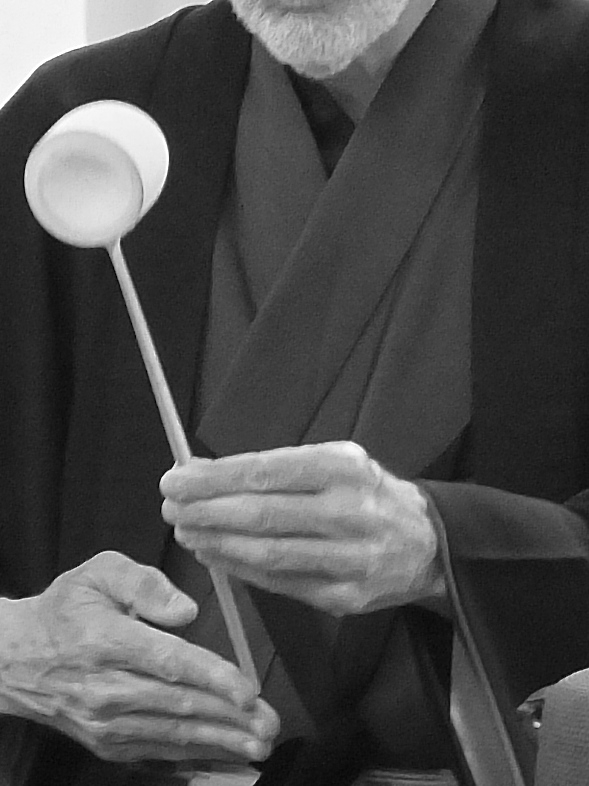
One of the frustrations of practicing chanoyu in America is the lack of appropriate utensils. Granted the Internet has made this less of an issue, but still there are things that are not readily available. I have spent my adult life searching art and craft fairs, and antique and consignment shops for that rare find, a suitable western piece that will work for tea.

Over many years of study, I have developed a sense of what foreign object will work in tea’s highly stratified world. My home is littered with objects that do not make the final step to being useful in the making of tea. Japan has spent close to a millennium defining and refining these objects, so why do I think I will find one willy-nilly while wandering around a crafts fair.

It has happened: a beautiful white tea bowl found in Door County, Wisconsin, and another bowl stumbled upon in a northern Maine coffee shop. But these are the outliers. Other objects I have made, partially out of a sense of frustration but also out of curiosity and a need to be hands on in my personal tea ethos.

This pursuit of a personal identification with the material world of tea is not always met with approval. Tea is a conservative practice in the way that period musicians only use instruments appropriate to that time; no Switched On Bach for them. And so, it is thus with tea.

Change is not bottom up but top down. It is not the purview of the general membership but the responsibility of the few. This is with good reason. As with most earthly constructs, chanoyu is a fragile thing. Change has ramifications, mostly unanticipated. Tea’s oeuvre is firmly set.

That said I have a library of tea books and a basement of tools, neither of which I can ignore. Once I get a design in my head, the above resources are put to work, and sometimes, if I am lucky a useable piece is constructed. Of course, this is an unorthodox approach.

In the book, The Spirit Of Tea, the then Grand Tea Master Sen Soshitsu XV touches on this subject in the chapter titled Selecting. I have read its twelve lines many times to try to understand where the boundaries between seriousness and frivolity lie. In this, I have been unsuccessful.

There are many ways to truth: scholarship, spirituality, physical practice, and the disciplines of arts and crafts. To be successful in the selection, or the design and building of tea utensils requires resourcefulness. But how to keep the ego out of it, well, chado, the way of tea excels at that.

April 2019

Friday, March 22, 2019

Prep

It is winter and I am retired. That means, for the most part, I do not need to leave the house unless I want to. There is comfort in this. It also means that I have the time to prep myself and the house for the onslaught of freezing winds, snow, and ice.

This winter (2019) has had a few particularly nasty days. I did not grow up with the concept of wind chill, so I tend to discount the figures as inflated for breathless weatherpersons, but reports of ten below zero grab my attention.

I retrieve the extra heavy black ski jacket. Next to be fished out of the back of the closet are fleece lined Patagonia pants, wool hats, and recently purchased Thinsulate mittens. I also rummage through the dresser drawer for long sleeved UNIQLO extra warm t-shirts, and just in case put long underwear on alert.

To add to this, I fuel the snow blower and start it to assure that when push comes to shove it will work. Snow shovels are strategically placed at the front, back, and garage doors along with containers of sand to prevent mishaps if the ice proves intractable.

And while in the garage, snowbrushes and ice scrapers along with shovels are placed in the car’s trunks. One car, an overpowered sports coupe, is slippery on anything other than dry pavement, so as a reward for a life spent driving beaters, come around November I fit it with four snow tires.

When the cold materializes windows and doors are searched for air leaks. Various types of barriers are employed to seal what is ultimately an un-sealable house. There is more but at the moment, I can’t think . . . . No wait, I oil the Bell & Gossett circulating water pump on the boiler, and bleed the radiators of accumulated air.

In late September, the storm windows are lowered in place. A portable electric radiator is put in the back porch and the crawl space underneath it is packed with fiberglass insulation. Of course, the front and back water spigots are drained along with what water is left in the garden hoses.

I have a few survivalist tendencies, so I stock up on pasta and canned tomatoes and red wine, and let’s not forget cookies and flour and yeast. To add to the above list, in September I did much the same thing to Carrie Rose, our handsome cruising tug.

Is it any wonder that Chicago’s population shrinks every year. Instead of constantly raising taxes and fees, the city should be paying us a hazardous duty stipend. The block I live on is magnanimous. Once I have the snow blower running I will continue south for three or four houses, and occasionally some gracious soul will clear the snow from the entire block’s sidewalks.

In October, I pull R. H. Blyth’s Haiku Vol. 4 down from the bookcase’s upper shelf, and read Buson’s haiku: My bones feel the quilts; A frosty night. That about sums winter up for me.

Only now can I take the liberty to think of winter’s preparation. It is March, and there is hope in the still frigid air.

March 2019


Friday, March 01, 2019

Boxes

Much of life is tucked away in boxes: hidden in attics and crawl spaces, in storage units and garages. An unofficial duty of mine is to patch together the multitude of boxes that contain the implements of chanoyu, the tea ceremony. Some boxes are pristine, others look like they have been through a war, and maybe they have.

Despite their artistic contents, they can be works of art unto themselves. They are platforms for their own history. The joinery is perfect. The wood is clear, fine grained and pale, though some boxes have the patina of age.

If there is a nail, it is because of an uninformed attempt at repair. For all the beauty and artisanship of their construction, Chicago is not a forgiving place for them. It is toxic. Japan is humid and so is Chicago, but not in winter. Humility disappears in January and February.

In my 1913 bungalow, cracks appear in the kitchen's wooden backdoor despite yearly attempts to mend them. The humidifier is turn up and while this prevents an almost fatal shock each time I touch metal, the humidity still hovers in the low thirties. The leaky storm windows break out in a forest of ice crystals with the added moisture, and still wood shrinks and cracks.

When the straight grained wood that these boxes are made from splits, it does so cleanly. Though I have never heard it happen, it must make a tremendous sound. Maybe it contributes to the constant creaking of my 106 year old house.

My first step in the restoration is to carefully inspect the box, and come up with a plan to mend the damage: less is more when making a repair. Often the wood is split and the dowels that act as nails are damaged. A judiciously sectioned toothpick will replace a dowel. With the new dowel in place, a bit of hide glue is added, and then hefty clamps are applied.

Most boxes have a rim around the bottom with four centrally placed slits. A ribbon is passed, though the middle of each. The middle of the ribbon meets the two straggling ends at the top. These, once tied, hold the lid on. The knot used is similar to tying shoes but of course, as I have learned, Japanese knots are tied opposite of Western knots. I grew up sailing and take pride my ability to tie knots, but these confound me.

Chanoyu uses a plethora of knots, which, of course, I thought I would be able to master. Think again. It is a constant frustration to be confronted by the same knots and fail each time to tie them properly without pedantic instruction.

The lids are made of the same wood as the rest of the box, but because of their construction, they tend to warp instead of split. There are two wooden rails on the bottom side of the lid to keep it in proper alignment. The rails are affixed to the lid with small wooden dowels. The dowels shear as the lid shrinks and warps. It is clever, because if they were nailed the lid would be damaged.

Though the glue sets in twenty minutes, I leave the lid and box to rest overnight. There is no hurry. Once returned to its owner, the box and its precious contents will be put away, and become a memory until needed. It could be months, it could be decades. The renewed box will again protect the little spark of life that went into the creation of the treasure within it: hidden or not.

February 2019

Monday, January 28, 2019

Handmade

I have built a few things over the years and in the process learned many skills: working with wood, metal, and fiberglass, and then often the most difficult, the final finish. This is one of the reasons I was drawn to Japanese culture. It was before I had developed any of the above. I was anticipating, however impossible, that one day I would be able to emulate the workmanship, the craft, and the creativity I saw presented by Japanese artisans.

If I am honest, even though I have built and designed things as disparate as boats and tea tables, I have never realized the competency and artisanship of Japan's craft practitioners. The tradition of arts and crafts in Japan is on such a high level that it is almost unattainable.

Think of a "simple" Raku bowl. It is rough and irregularly shaped, it is grossly black, and it is a bowl with such a specific purpose that it is useless to most. But for tea, it is the perfect vessel. Though it looks heavy, it is light. Fill it with hot water and it is the perfect insulator. Behold it filled with whipped, frothy matcha, the green within the black surroundings, and the natural world is revealed.

This is the same for many of tea’s utensils. Consider the natsume, the tea caddy. Depending on its shape, the matcha within is carefully placed into a steep volcanic peak or a low lying hill. In use, the natsume is placed close to the side of the chawan, the tea bowl. The right hand while grasping the chashaku carefully removes the lid. The matcha now conjures up an image of a tree covered mountain, or a mossy hill.

We learn over time to disturb the perfectly formed mound of matcha selectively, creating a crag in the far off side. The totality remains, if not in reality, then in the minds eye.

Tea utensils have evolved with the practice of tea. The ten craft families that collaborate with Rikyu’s descendants are dynasties of their own. They continue to supply the ceramics; cast iron vessels; pottery; bronze; silk cloths and containers; various wood and bamboo pieces; lacquered paper and wood; and the other paper products that make tea possible.

And though Rikyu stated that, “it is foolish to possess numerous utensils", surely chanoyu would be found lacking without the tradition of design and execution these families bring to tea, to say nothing of their historical significance.

I do not diminish my skills but I am humbled by the art and craft of even the simplest of tea wares. Whenever I am working on a project, their example keeps me honest. Each bowl of handmade tea draws upon this four hundred year legacy, of what Morgan Pitelka calls in his same named book, Handmade Culture.

January 2019

Friday, December 28, 2018

Devotion

To excel at a task requires devotion. Of course, devotion alone does not guarantee competence but that hardly matters. What matters is the work, the striving for perfection without the anticipation of it. I do not speak of devotion to a faith or a supreme being. That is too abstract. I speak of a more personal, hand crafted effort.

The ranks of stalwart pianists and violinists have diminished and so, in their place many fresh faces have appeared. It is comforting to see and hear them. Music has definitely changed. There are new interpretations of classic pieces. And the level of virtuosity has sky rocketed.

Most of these new player’s biographies begin while they are four or five years old. In the past, these musician’s lives would have been considered freakish, but not now. It seems to be standard operating procedure. Just like in sport where athletics become taller, faster, more coordinated, and break every long standing record, so with music. Exceptionalism has become the norm.

This of course does not mean that they have something to say, or something to add to the interpretation. In the process of searching my library’s music section, I have listened to many new artist recordings. The standard fare is Chopin’s Etudes or Bach’s Partitas. These pieces seem to be the coming out party for young phenoms.

They do not always have something to say. The music can be technically flawless but lack heart. There are many ways to read the notes and measures. There are many ways to hit a piano’s keys or to pluck a violin’s strings. The variation is infinite even within the constraints of classical music.

But I error, Bach does not micro-manage. The scores have plenty of freedom to allow for personal exploration. And with venues like SoundCloud and YouTube, no one can force a musician to conform to a specific view. If you have the skill (or not) and an iPhone, there is a platform to share your view of the world with others.

Persistence in developing the intellectual and physical skills, even in the face of seemingly insurmountable odds, is the key to unlock the constraints hidden within us. It does not matter if the skill desired is playing Danny Boy on the penny whistle for your friends on St. Patrick’s Day or performing a Beethoven Piano Sonata in Carnegie Hall.

In my world, I have been practicing chanoyu since 1984 give or take a decade to concentrate on a career. In all that time my goal has been to make tea without worrying about making tea. It is odd to see that in writing. What is the big deal about that, but it is elusive. There is always second guessing and self doubt creeping in. It creates a roadblock.
The mere fact of doing tea repeatedly in every possible combination, with many types of utensils, with seasonal changes breaks down resistance simply by exhaustion and complacent familiarity. Without devotion, practice devolves into a chore, comforting maybe but fruitless.

And though it is a month too early for a New Year resolutions, mine next year will be to be more devote. Not to an external entity or institution but to myself. To expunge self doubt and get on with the task of living the years left to me in a fashion that may not lead to Carnegie Hall but to excel . . . competently or not!

December 2018

Sunday, December 09, 2018

Rising

My mother was a cook and a baker. These are not always compatible traits. To prepare her wonderful Sicilian dishes required a kind of slapdash attitude. Rarely was there a recipe. It was the little-of-this-and-a-little-of-that school of cooking. But when it came time to bake, the recipes came out, as did measuring spoons and cups.

I learned that baking is deterministic. The recipes have to be trusted, not questioned. And that cooking is a more egalitarian pursuit. I am skeptical of a recipe until it has been proven. If an ingredient, or an amount, or a procedure, or a temperature, or the timing does not sound correct, I have no compunction about changing it.

Now that I have said this, it does not apply to baking bread. Bread occupies a space between cooking and baking. It did not when I first began to bake. That was in Southern Illinois, Carbondale to be precise. It was my second attempt at college. I was twenty-five and a bit desperate to move on with my life.

At the same time I decided to become a vegetarian, I still am. Carbondale had a slightly world weary hippie feel to it. There was a lot of the counter culture mixed in with academics, partying, and environmentalism. This was packaged in a small rural town 350 miles south of Chicago. It turned out to be a good place to reinvent myself.

My first loaf of bread was a failure. It resembled a rough brick and weighed about as much. No matter, the apartment smelt good and I was the envy of my friends. I ate every bit of it all the time recognizing its deficiencies. Learning to bake was an off and on thing. I was busy, my mind was busy, my body was busy, but I kept at it. It was like chasing the Holy Grail.

I cannot remember when I finally succeeded but it was decades later. By then, I had stopped referring to recipes in favor of ratios. To fill two trusty ceramic bread pans I start with two cups of water. Once I had the feel of the dough, measuring the other ingredients is unnecessary. Yeast, salt, oil, and sugar are added by intuition.

That said there are a couple of inviolable truths that cannot be varied if bread is going to rise. The first is pure microbiology (my favorite class in undergrad): do not kill the yeast. Yeast is a living thing, even if dormant.

Recipes often break down here. Some will give specific temperatures implying that the yeast will not grow unless the temperature fits into a tight range. Some are more vague, stating that the water should be luke warm, whatever that means.

Yeast is a robust organism. It has been found to function even after thousands of years sitting in a Pharaoh’s tomb. The only thing it cannot take is heat. A temperature over 120 Fahrenheit/49 Celsius and the yeast is dead. Yeast will rise in cold water it will just take longer, so if not sure, error on the cool side. If you are more scientific or have a background in engineering, and cannot proceed further without a precise temperature; then use 100 Fahrenheit/38 Celsius.

The second truth is that the second rise cannot be prolonged. The first rise is not a concern. Put it in the refrigerator overnight; leave it in the kitchen for hours, all that’s needed is to punch it down and start kneading. The flavor may even benefit from its neglect. But once it is rising for the second time it has to be watched. Too high and it will deflate, a sinking feeling.

There is this concept not often discussed called oven rise. The yeast soaks up the heat of the oven and starts metabolizing CO2 and alcohol. The bread rises until the yeast is killed. If the dough rises too high before being put in the oven, its gluten backbone cannot sustain itself and down it comes.

Spend the last half hour of the second rise sitting in the warmth of the kitchen and watch the miracle happen. And just when it starts to peak over the rim of the pan slash the top and put it gently into the oven.

Bread inhabits both worlds. Precision and a laissez-faire attitude are needed to produce a memorable loaf of bread. I guess this is what I learned from watching my mother cook and bake. And when I think of it, it is probably not a bad way to live a life.

November 2018


Friday, October 26, 2018

Reality

Though I have been involved with Japanese culture for decades, my Japanese language skills are sorely deficient. I admit that I have never put the effort in to learn the language of the culture that I love. One of the side effects is that I am constantly learning the obvious. It also means that the simplest of revelations is exciting.

I have been to Japan three times: travelled from Nikko in the north to Nagasaki in the south. In these travels, I have never felt looked down upon because of my lack of the language. In fact, the Japanese people have been welcoming and on numerous occasions gone out of their way to rescue me, usually because I cannot read the simplest of signs.

And this has me thinking about Japanese prints, Ukiyo-e. What could be more mysterious than the various seals, stamps, text, and calligraphy that accompany the subject of most prints. The figures or the places depicted are framed in, at least for me, an incomprehensible array of kanji and bright red hallmarks.

Once, years ago a friend who was born in Japan but has lived in the USA for most of their adult life came to visit. They had only two requests, they wanted to see the Art Institute’s Japanese print gallery, and then have dinner at the Italian Village. As we walked through the gallery, which was displaying a grouping of classic prints by the like of Hiroshige, Masanobu, and Hokusai, he casually looked at each print and simply read the text.

This was a revelation for me. As obvious as it was, it had never occurred to me that these prints were formatted with a particular array of identifying and regulatory markers, and that on many were poems and descriptions of the depicted scene. What was a mystery for me was, in most cases, the set series of elements that make up a print's bona fide.

So, after that faithful afternoon I determined to understand the prints on a more practical level. To this end, I began to acquire scholarly books about the prints. At one point, I even make a spreadsheet of the various “families” of print makers to try to understand their lineage.

Of course, as might be imagined, it was a complex task. In the process, I learned that the production of the prints had a definitive timespan, and that the printing technology evolved, as did the availability of inks from outside of Japan. And those are clues to when the prints were made.

I also realized that the artists listed on the prints were the designers, and an entire industry existed to make the artist vision a reality. Woodcarvers, printers, publishers, and a sales staff, not to mention the clients that ordered the prints and the public that bought them. For printmaking was a commercial enterprise.

In the years that I sought out these prints, I had put my uninformed interpretation on them, an idealized image of a perfect world without mercantilism. After all, I was thinking Zen, and not the reality of courtesans, Kabuki actors, and travel brochures.

But let me not sound disappointed by my discoveries. In fact, it only heightened my enjoyment of the medium. Knowledge is a grand thing and with the more gained, the increased frustration that more is lacking. Knowledge, like the proverbial iceberg, is mostly hidden.

Does this mean I will sign up for the next Japanese language class, probably not. I will use the brainpower still left to me to study the culture knowing the deficit I am operating under. And that is the reality; to continue to rejoice in each small discovery I stumble on.

October 2018

Monday, October 01, 2018

Sound

Neuroscience has caught up with common sense. Since the scientific method was discovered it was thought that past a certain age, it was downhill for an aging brain. That once neurons matured the only option was deterioration. Our neuronal architecture was fixed and there was nothing to do about it.

Of course, life long learners knew differently and kept the knowledge to themselves. They quietly painted, wrote, read, built, and played despite the grim prognosis provided by the scientific community.

This has changed. Our neurons are now free to grow and interact as they please. And this brings me to the title of this article, sound. I spent most of my life listening to all kinds of sounds from the most esoteric Japanese to ubiquitous pop, and just below the surface longed to play, to participate.

I had (have) a busy life. With the other study I involved myself in there was no place for music making. In my early twenties, I bought a shakuhachi and managed to learn how to read the music but that is about as far as I got. Once a decade I would pick up the flute but to no avail, other mental activities had sucked up the brainpower needed to progress, and the flute would be confined to its drawer.

This was true until four years ago when I quit working. It took me a couple of years to say retired. I think it was a combination of guilt and self denial, but I am over that now. And then with no excuse and plenty of time, I picked up the shakuhachi once more. Of course, making notes other than the basic pentatonic scale of D, F, G, A, C was troublesome.

I purchased a tuner/metronome and went to work. An uncompromising friend who is an amateur oboe player stressed that I practice at least one hour per day, otherwise forget about it. I agreed. It seemed like I was making a pledge, signing a contract with dire consequences if I did not comply.

Now retired and having numerous hours free how hard could it be to find one hour to practice, as it turns out, very. Mornings and evenings are productive times for me, afternoons not so much, unless I manage to sneak in a shot of espresso around 2:30.

As retirement progressed, I noticed the morning rituals did also. During my working life I was able to wake, shower, make tea, and a breakfast and lunch sandwich, and be out of the house crawling down Lake Shore Drive in twenty minutes, now the task (minus one sandwich and the commute) was taking hours.

This severely cut into my attempts to practice first thing in the morning. I thought there is always the afternoon, no problem. In this, I did not take into account that I do not live by myself. My wife Charlotte and I are a good team and it turns out afternoons are for teamwork: groceries, maintenance of the house and garden, haircuts, and financial advisors, accountants, doctors . . . well you get the idea. These duties often interfered with the above commitment.

Then there are the intangible reasons (read excuses) for not practicing. Self doubt even loathing is a prominent one. To sit quietly and listen to someone else make music/noise is one thing but to make your own noise is entirely different. Why do I think that I have or will ever develop the talent that could justify making the constant stream of mistake ridden sounds needed to become proficient?

Where in the confines of a 1200 sq. ft. bungalow with neighbors feet away to either side can I practice without disturbing the good will of folks we have lived peaceably next to for decades. And what about my spouse? She has graciously supported me in pastimes from chanoyu to welding steel sculptures to basement boat building to sacrificing home improvement in favor of boat upgrades. Can I push my luck one more time?

To this end, I decided to set up shop in the dining room, and then in deference to the close proximity of the southern neighbor’s bedroom I moved into the front room. I can close two doors to slightly isolate the sound from the TV room in the back of the house where Charlotte resides most evenings.

If there is one common thread in my diurnal existence, it had been night owl-ism. When sent to bed as a kid I would lay awake for hours conjuring up fantasy worlds. This would have been a good time to read under the covers with a contraband flashlight but I did not figure out how to read until late in my high school career.

So, it ends up that when the sun goes down my energy level goes up. Since cable has been ousted in favor of an antenna, and attempting to keep up with the providers of the ever-changing Internet stream has proven beyond my skill or interest level, there are not many distractions after dinner. Other than the fact that the rest of the world is quiet, it is my perfect time to blow.

The shakuhachi is not a forgiving instrument. There is no guarantee that the notes played the night before will again be present on the next night. This ancient pentatonic flute lives in a chromatic world, and the changes in embouchure, air speed and direction, unique fingering, and the variegation of each tube of bamboo make each session an adventure.

Not to sound defeatist, I have made progress. I have even garnered the occasional compliment from long suffering Charlotte. The sound has improved and I have learned to play softer and slower. There is less tension in the notes, and less sharp and flatness.

I can feel neurons remodeling. It happens in the guise of muscle memory, in the four or five songs I have been able to memorize, and above all, in the eighty year old flute’s response to my entreaties. It has finally recognized my existence, the sound of my newly minted neuronal architecture.

September, 2018

Phenomena

At first light, the lobstermen wake Carrie Rose as they transit to their boats. And not long after sunrise, other lobster boats wake Carrie Rose as they stream in to check their traps. I am usually up with the former, go back to bed and have the latter wake me up for good. Fishing is just one of the phenomena that occurs here on mooring ball #14 in Herrick Bay, Maine.

When the moon disappeared this month of August, the tide was particularly low. Where I usually have 8 to ten feet under me at low tide, there was less that five. It rendered my outboard useless at the floating dock where the water was less than three feet.

All the obstructions to navigation around the dock became visible. New smatterings of rocks appeared throughout and the bay’s boat traffic halted for several hour pre and post low tide.

Then there is the fog. Locals have told me that this year has been particularly bad. It rolls in and it rolls out. It hugs the water only to rise and hug the shore. At times the water particles that make up the fog are visible, each one its own entity. And with the fog comes the cold. One moment there is the sun’s warmth, and the next the fog’s chill. It makes choosing the day’s wardrobe a lesson in compromise.

One morning I awoke to a fog so dense that I could not see the boats around me. A steady breeze was blowing from the southeast and there was a hint of blue sky above me. I was tinkering in the pilothouse when I noticed that the fog had cleared around me and had coalesced into a parabola shape streaming off Carrie Rose’s bow and stern. It was rainbow-ish: more shades of browns and purples than the usual Technicolor.

As the boat swung, it undulated but stayed attached. I went to the bow and took pictures and a three minute video, and then I thought that I should just watch it. And so, I did until it slowly widened and disappeared deep into the bay. I know you are going to ask if I checked the boat for a pot of gold, I did not, figuring that boats are more generators of debit than revenue.

The night before my personal rainbow I was sitting below in the salon. It was dark and foggy. There were only a few dim lights visible on the shoreline and the ghostly yellow hue of my solar garden light illuminated the stern. The lights in the pilothouse were off as I walked up the stairs where I confronted a brilliant 7/8ths blood orange moon about 30 degrees off the horizon. Its reflection was streaming towards me and the entire bay was ablaze.

It took me by surprise. I was expecting a void and instead I saw an otherworldly landscape of water, islands, and boats silhouetted by the moon’s bronze glow. I almost fell back into the salon. Of course, I went for my camera in an attempt to capture the few photons streaming around the boat’s wobbling platform, impossible. Again, as with the rainbow, I gave in to the image and watched.

Some days later, after a day of rain and fog and threatening thunderstorms the skies began to clear. It was close to sunset, so I kept watch on the western horizon. The skies were chaotic enough to offer a chance for a stunning sunset, always welcome after days of low clouds.

A thunderstorm passed in the distance. It’s lightening was audible as it headed to the northeast. The girth of the storm seemed to draw in other substantial clouds, which began to organize on the horizon. I have seen clouds like these before. They are roll clouds that form, if I am correct in my analogy, like the vapor seen on the front of jets wings. Pressure causes the humid air to condense and become visible.

Though these clouds look formidable, they usually do not presage a violent occurrence. Nonetheless, I do not ignore them. My eyes were drawn into their pure symmetry and relentless movement. I prepare for the worst but am most times relieved by their inconsequential passing. They seem to signal an end to the chaotic weather, but on occasion portent a worsening. So, I stay beware and count my blessings if they pass silently.

There are other stories but my computer’s battery is getting low and the two fingertips that I am using to type this are sore, so I will stop. Phenomena are one thing, despite the challenges, that keep folk like me on the water. May they all be benign!

August, 2018

Aviary

Chamcook Harbor is a small inlet off Passamaquoddy Bay. Passamaquoddy Bay is a larger inlet off the Bay of Fundy, and the Bay of Fundy is an even larger inlet connected to the Atlantic Ocean.

The tide here is seventeen feet, so when anchored in 21 feet at low tide enough anchor chain had to be put out for in six hours it would be 38 feet. 120 feet (all I have) of 3/8 inch chain was lowered connecting Carrie Rose to a hopefully well buried 45 pound anchor.

Chamcook has a pair of loons. Loons keep their distance unless they are trying to dissuade you from approaching their youngsters. The Chamcook loons did not get much closer than a football field. I was to begin my daily shakuhachi practice (Charlotte is a saint) when the loons started calling to each other. As much as they are the butt of jokes, their call penetrates the soul.

It was a cool night after a 94 degree day. The 100% humidity made it seem warmer than it was. I had a vivid dream about trying to find my apartment at the hospital, and got wrapped up in the sheet and blanket, quite frustrating.

The cloud shrouded sun rose at 4:50 AM. I managed to ignore it until six. I boiled water, made tea and toast, and sat down to eat when I noticed five black dots about 200 yards outside the port salon window. At first, I thought they were the eider ducks that flew by low to the water the day before. I grabbed my camera and took a few pictures before using the binoculars.

What I discovered was the loon family out for a swim. There were the parents and three young football sized youngsters. My experience with loons is that the kids are kept near the shore hidden from danger. The parents will be fishing but aware and will intervene if anything threatens their babies.

Carrie Rose has been stopped in her tracks by a couple of determined loons. So, to see the five of them together in the middle of the bay was a surprise and a treat. I went back to breakfast and when I looked up again there was only the parents. They had stashed the kids near the shore.

There was some commotion and suddenly the parents were airborne. One flew direct at me. I grabbed the camera again but it would not focus on the grey underside silhouetted by the sky’s homogeneous gray background.

Loons are big birds and powerful fliers once they manage to get off the water’s surface. Their large black feet stream behind the tail feathers. They joined in formation with one leader and a tail gunner, and flew out the opening of the harbor into darkening clouds and fog.

Sometime later, I thought I saw them again but there were only four. These were eider. A male I think and three young brown birds. They paddled to shore and simultaneously disappeared beneath the water only to pop up and start to preen. Carrie Rose makes a good perch to observe the local waterfowl.

Later that morning, mother loon and two beautifully marked siblings spent a few hours fishing to the north of us. The wind steadily increased from the west. We received some strong gusts but the bulk of the wind was pushed over us by the low slung hills.

All morning we had loons to the starboard and eiders to the port. The loons were more active but then they were older, already decked out in their adult plumage, whereas the eider mom had four small rust colored children to contend with.

She would fish ahead of them as they floated downwind. Each time she came up, she looked back to see them farther away until judging the situation untenable, she swam back to corral them and moved forward. They stayed in a neat little buddle, while the loons roamed freely.

The wind sped up and with one particularly strong gust, a large black bird flew over the western hills. It clawed high in the sky, hovered, blew downwind, and repeated the same maneuver until it was out of sight. It was big. I thought B-52, but then a B-52 would not have finger like feathers pointing horizontally in line with its long slender wings.

I captured a fuzzy picture of it hovering directly in front of me and noticed whitish feathers under the wings close to its body. It was an immature bald eagle fishing in the harbor, off the bays, attached to the Atlantic where Carrie Rose spent an eventful morning spying on the bird life.

July, 2018

Fluffy

Early to rise one recent June morning, I decided to take a walk around Montrose Harbor, a place dear to my heart. The place where I learned to sail and where, in many ways, I grew up. It is also where Carrie Rose, our 32’ Nordic Tug, was moored for over a decade.

This June will be the ninth year since Carrie Rose, and us, left Lake Michigan and our mooring at Montrose. We have traveled thousands of miles through Lake Michigan, Lake Huron, the canals of Canada, Lake Ontario, the St. Lawrence River to Lake Champlain and the Hudson River, out into the North Atlantic along the coast of New Jersey to Chesapeake Bay and last year north to Maine where she sits awaiting our return.

A few highlights have been the canals of Canada, the wind and waves and weather especially on the Great Lakes, the sincere and earnest people of Vermont, and then NYC. How exciting to motor on the Hudson under the Tappen Zee bridge, pass the Palisades and into downtown Manhattan with as much hustle bustle on the water as on the streets.

There was the trepidation of leaving, passing through the Verrazano Narrows and around Sandy Hook for the first time into the North Atlantic and south on the New Jersey coast. The New Jersey folk were as gregarious, as their coast was treacherous.

Then to Chesapeake Bay, which at first seemed an isolated cruising ground, but turned out to be surrounded by millions of people, with a McMansion around every bend. The year spent there was one of the hottest ever, 100 degree plus everyday. But we were in the perfect spot, and though we did, we rarely needed to travel more then twenty miles for another perfect anchorage. There were so many eagles that at first I mistook them for flocks of crows.

Last year (2017) it was north to Maine. Throughout the cruise, we interacted with multiple diverse communities and cultures. Though not historically true, America seemed to get older the farther north we went. I think because much of the “oldness” is still present. It is in the buildings, in the speech, in the food and drink, and in the attitude of the people.

When we finally crossed the border into Maine the isolation was palpable. The coastline is more on the edge and the lobster culture predominates. Carrie Rose negotiated dense forests of lobster buoys, which predominate the landscape at about one per square foot. It is hard to imagine how the cages sort themselves out on the bottom, as it is to believe there are enough crawly lobsters to fill them.

This summer Maine’s coast will be explored. The water is deep and cold; the tides are eleven feet or more. I am thinking of this as I sit on the Montrose Harbor promontory. I can see the center city with cranes building taller skyscrapers into the perfectly blue sky. There is just a fringe of clouds, lacelike in the distance outlining the blue green water.

There are only a couple of boats out on the lake. The cribs sit stoically three or four miles offshore. A slight breeze disturbs the surface just enough to obscure the reflections of the buildings on Lake Shore Drive and in the distance the sun’s rays are sparkling off the wavelets.

Along the abutment, it is obvious that it was a drunken melee over Memorial Day, cans and bottles, smashed and broken, litter the pale concrete along with trash. I am depressed to think that the revelers can be so clueless to make such a mess for someone else (hopefully) to clean. But I choose not to dwell on the negative this glorious spring day.

I have inhabited this place since I was a kid on a one speed bike. Back then there was a group of German immigrants, many trained in the classical arts of stonework that chiseled and craved the limestone rocks that made up the shoreline into beautiful images. Images of mermaids and moon landings and family crest were painted with vibrant colors. They tolerated me and even gave me tools to do my own primitive memorials.

Little by little, as limestone is apt to do, the paint faded, the sharp chiseled corners rounded, and their world disappeared. I wish I had a camera for now I fear the images only exsist in my mind. The lake reclaimed the wood and stone to the point where it has been replaced with a functional but sterile series of concrete steps.

The Great Lakes are a magnificent background to live one’s life, and representative of that, is Montrose Harbor’s Magic Hedge. It provides a resting place for thousands of birds migrating north and south along the coast. The hedge, born out of neglect and saved by the local birding community, is a world famous site amidst a decidedly urban setting.

The rustic hedge is packed with birds, some exotic and some not, depending on the time of year. As I walked through it that morning, I kept waiting to be attack by one of the cranky red-winged blackbirds. Lucky, I escaped injury.

When I started to walk along the harbor, fluffy fledgling geese were laid out helter-skelter on the boat ramp. Their necks placed haphazardly as they stretched pitch-black legs readying them for another day of foraging. Compared to their alert caretakers, their lethargy was striking.

So this is my tale of a June morning spent wandering in familiar territory that I still find full of surprises. A place that keeps me here, and a place I think of when people from afar ask me how can I stay in Chicago, and I always say, “How could I leave!”

June 2018

Caution


In 1973 with Crosby, Stills & Nash reverberating in my ears, I grabbed a backpack, stuffed $700.00 in my pockets, and flew to Tel Aviv. It would be a year before I walked on Chicago’s grey fields again. Israel felt like the frontier. Its people were fresh faced and optimistic. Young people in khaki shorts with automatic rifles slung from their shoulders were commonplace, as were tanks on enormous transport vehicles. Phantom and Mirage fighter jets owned the sky.

I landed on a large kibbutz located on the western slope of the Valley of Israel. Its one thousand souls milked cows, raised beef, picked oranges and grapefruits, raised hundreds of thousands of chickens, and operated a sizable plastics factory. I would spend most of my time there at the bottom end of poultry husbandry.

Intelligent and serious young men toting Uzi’s patrolled the perimeter of the kibbutz. Israel (at least the kibbutz) was an open-air community. There were hardly any walls. The kibbutzniks were a hardy lot.

The founders had lived through pogroms, the Warsaw Ghetto, and the diaspora. Some had fought in WWI, WWII, lived through the Communist Revolution, and then the expulsion of the Palestinians and the wars that followed. In their spare time, they built a robust agricultural-industrial economy. My contemporaries had been involved in a war and endless policing actions.

The country’s population at the time matched that of Chicago and was looking to expand. There were folk from all over the western world. Intellectuals and farmers, engineers and tradesmen, politicians and every kind of military professional, but surprisingly there were no religious zealots amongst the group.

Their kids were raised in dormitories. The boys were steely eyed and the girls were fiercely independent. I realized that I was out of my league, and kept a low profile and an ear to the ground. The first month I was hardly noticed. After the third month, the place gradually warmed to me and exposed some of its raw nerves. I made it through six months and if the Yom Kipper war had not loamed, I might still be there.

In the end, I survived the non-stop parties, kicking an exposed grenade down the road, near tractor accidents, multiple encounters with large hell raising roosters, and hitch hiking from the top to the bottom of the country.

I lived with Arabs in the Old City of Jerusalem, had tea and snacks with Bedouin shepherds in their tents, walked amongst the shuckling Orthodox Jews at the Wailing Wall, rode the back of a spirited horse into the hills after ranging cattle, danced to a mean blues harmonica, and for some reason spied on an Israel Defense compound. If I keep remembering, even I will get bored with this list.

For a squirrely teenager with limited reading skills the reality of Israel was a kickstarter. It set me on the road for many future adventures. Now as I approach Social Security, I wonder if it is a cautionary tale or one of the best things that ever happened to me. I’ll take the latter.

May, 2018

Friday, March 02, 2018

Questions

Chanoyu, the tea ceremony, is heavily depended on dogu. The word dogu curiously translates into instruments of the way, or roughly into the tools and utensils necessary to prepare matcha. Of course, it is a difficult task to recreate an entire culture in a foreign land. So sometimes, dogu from foreign lands are used. How to decide if they are appropriate is always a question worth considering.

I attend chanoyu lessons on Tuesdays and I anticipate the unique objects of wood, pottery, or metal I will see and for that matter, use. It can be a chawan (tea bowl), a mizushashi (cold water container), a chashaku (tea scoop), a tana (tea stand), or a natsume (matcha container).

Or it can be a scroll, a kogo (incense container), or ephemeral things such as chabana (flower arrangements) or sumi (charcoal). Many times, it is all of the above. In fact, when preparing to make matcha for guests it is expected that the dogu will be distinctive. The appreciation of the dogu is one of the joys of the practice.

And to add a question, I often wonder how do we in the west with limited means, availability, and knowledge uphold this tradition of appropriate utensils? It is difficult but not for the want of trying, something I know from personal experience.

My approach to this dilemma has been to create objects for chanoyu out of metal and wood. The designing and building helps to control my frustration with not having access to dogu. Each object made and used provides a further understanding of what makes the craft traditions of Japan exceptional.

Think of the subtleties that the tenth or twelfth or fourteenth generation of craft families infuse into the utilitarian objects they make. Each detail on every chawan, chashaku, or natsume, just to name a few, is a conversation piece.

An area of scorched glaze brings visions of ancient wood fired step kilns belching with flames. A swirl of grain on a wide unfinished wooden board envisions a deep forest of monumental trees. A wrought iron kettle’s patina conjures up the many hands that have ladled steaming water over its hot surface. These images make a simple bowl of tea worthy of a lifetime of study.

Of course, we have to be aware of substituting avarice for utility. Last year I was reminded of this at a fellow association’s gathering. The quality of the dogu, even though described only in Japanese, could not be ignored. I could feel several of the seven deadly sins creeping into my psyche.

It reminded me of one of Rikyu’s One Hundred Verses: Keep tea rustic and through your heart, give warm hospitality; always simply put together utensils you already have. Good advice to follow from the founder of wabi tea.

So, after pondering the above, I conclude that I have not asked the correct questions. The only question that matters is when is the time to start studying chanoyu, and that time is now!

February 2018

Sunday, January 28, 2018

Incident

One cold winter’s day Charlotte and I were riding back from visiting the galleries at the Art Institute of Chicago on a Chicago Transit Authority’s elevated Brown Line train. If possible, we catch the first car because I never know if the best seat on the train will be vacant. On that day, a well-tailored older man and his briefcase occupied it, so I had to contend with a seat that looked out to the right side into everyone’s backyard.

My coveted seat is to the left of the driver’s compartment and its window looks forward onto the tracks. For some perverse reason the designers placed this seat facing into the train. This means if anyone older than ten sits there they will get a stiff neck twisting to look out the window. Not that that stops anyone.

On the Brown Line the seat’s vantage point is especially fun because of all the twist and turns it takes on its trip from Kimball to Clark/Lake and back. Of course, when travelling south, the best part begins after the Merchandise Mart station when the train crosses the Chicago River and enters The Loop. The Brown Line’s course (or as it was known when I was a kid, the Ravenswood) would make a great Formula 1 racecourse.

Our now northbound train stopped at Southport, one of the twenty-seven stations served by this noisy squealing train. The doors opened and with it, a cold rush of air swept in two young boys with their mother in tow. In tandem, their voices rose to a falsetto as they sprinted to the seat despite it being occupied.

Their mother’s urging to slow down went unheeded. Joy emanated from their voices as they sped towards it and him. He immediately recognized his predicament. With a vigor that belied his age, he grabbed his briefcase and vacated the seat just as the boy’s knees landed on the thinly padded fiberglass.

The doors closed as their noses connected to the cold window just in time to witness the train’s departure. She looked at the man with a face that begged a combination of understanding and forgiveness. He smiled a knowing smile as he organized his kit and detrained a few stop later. I watched the boys transfixed by the speed, motion, and noise that only a train can make as it careens down the tracks.

The above incident reminded me of riding in the same seat with my young mother. The two of us were frequent travellers to and from the Loop. We would leave early Saturday morning and be back home for lunch. I would do my best to follow my energetic mother as she did her errands: Merle Norman for cosmetics, Stop and Shop for food, the mysterious safety deposit box for who knows what, and Marshall Fields just because it was Marshall Fields.

I also remember roasted Spanish peanuts and chocolate covered strawberries, grilled cheese sandwiches and Frango Mint ice cream, and a few small Matchbox cars and trains that I was occasionally gifted with. Every time I ride, please forgive the reminiscence, the Ravenswood train these memories are not far back in my consciousness. I still covet that seat . . . I do!

January 2018

Friday, December 29, 2017

Truth

A seminal album of the 1960’s is John Coltrane’s A Love Supreme. It was his search for truth. Music was never the same after it. To follow his path is to watch jazz evolve (or devolve, depending on your opinion) from dance music, to improvisation, to bebop, to Avant-garde, and then to something indefinable. To say he was an innovator, though he certainly was, is to miss the point. How many musicians have a church named for them?

Coltrane’s My Favorite Things and Greensleeves were top forty hits, while the later work was derided. His music went from straight ahead jazz to straight out of the universe. A Love Supreme balances between tonal and atonal. Any listening will benefit from scholarly input and a historical perspective; in that way, it is similar to James Joyce’s Ulysses.

A Love Supreme is a four part suite. It is at the same time polished and raw. It was recorded by Rudy Van Gelder, the legendary recording engineer, and retains the excitement of a live performance. Minimal instructions were provided to the other three musicians and so, their genius shows through.

My interest here is in the fourth movement named Psalm. It has a vocal quality because he is chanting his poem, A Love Supreme, through the tenor saxophone. The poem can be read almost note for note as he plays. “Thank You God”, a three note phrase punctuates Psalm’s seven minutes nine times.

As I listened repeatedly to Psalm, I am reminded of the obscure Japanese music called Honkyoku. It is played on the shakuhachi, the venerable two or so foot long piece of bamboo that holds the distinction of being a meditative instrument that doubled as a weapon.

Honkyoku is solo and meditative. It is not considered music by some of its most adept adherents. The music is ancient, and is based on the sounds of nature and in some cases transcriptions of monks chanting. I admit that I cannot prevent myself from looking for structure within the music. The repertoire shares a vocabulary of short passages but as far as a beginning, middle, and end, well it is not obvious.

The music begins and ends without fanfare. It is as if it will go on forever with only the inhalation of breath to mark the passage of time. In this, it differs from Coltrane’s masterpiece, which has a beginning and end. I think this troubled him and his later work tried to address the infinite qualities of God’s love.

I spent decades hidden away trying to master the shakuhachi by playing doyo (children’s songs) and minyo (folk tunes). A few years ago, I came out of my shell to pursue lessons, and purchased a traditional Japanese instrument. Let me say that both the above required more of a learning curve then I would have thought.

But as with most things persistence pays off. Now with a newly tuned flute and a talented teacher I have made progress. I still cannot see the end of the tunnel, but I know that one exists. The one thing that my teacher instilled in me is not to fear the music. I often see this lack of fear in artists I admire. This lack of fear allows them the freedom to express the true nature of their work. Of course, it is no guarantee that it will be accepted or that it will be competent but that is irrelevant to the practice.

John Coltrane and Honkyoku’s inspiration relies on the true and unknowable nature of the universe: one with a secular concept, the other without any at all. So, for me, the notes on the page will remain just that until I can discover the truth within myself. And in that pursuit, I may be running out of time!

Deacember 2017

Thursday, December 07, 2017

Chabana

Rikyu, the founder of Chado, the Way of Tea, said to arrange flowers as they exist in nature. This practice became known as Chabana. I have often wondered what does he mean by this. Are we to take his words literally and how do we, practicing chanoyu in Chicago’s brutal climate, emulate the milder climate of Japan?

His simple aphorism has plagued me and because of that, I have sidelined the study of flower arranging in my practice of chanoyu. It is only recently, now that I am more comfortable in my tea making skills that I have begun to contemplate flowers.

In the practice of chanoyu, seven exercises take chance into play. They are called kagetsu. A small paper pocket contains chits, which are randomly chosen by the five participants. These exercises put different aspects of chanoyu into play. One person brings the tea utensils in, the next makes a bowl of tea, the next drinks, all determined by chance. In one koicha (thick tea) is made, in another the charcoal is laid, and in another flowers are arranged.

There is no way, except to devote a life to the study of chanoyu, to prepare for kagetsu. A chit is picked, a task is done, and as the exercise progresses everyone moves into different position within the confines of the tearoom. In the basic exercise, only bowls of tea are made. And at the end, the participants do a military like march to regain their original seats.

It is quite fun, and engenders much giggling and consternation. Though it appeared to be a game, that is until I took part in it, and then, despite the giggles I realized it was deadly serious.

But this is a long introduction to my original thought about Chabana. I was never called upon to arrange flowers until I participated in one of the above exercises. It left me dumbfounded. There I knelt before the tokonoma with a small wooden tray beside me. A knife, a small watering can, and a mass of flowers and leaves rest impatiently on the tray. In front of me was a tall cylindrical vase.

I do not remember if the vase was bamboo, ceramic, or bronze. I do not remember the season or the type of flowers. All I can remember is my lack of inspiration. Kagetsu moves along. It is not meant to be contemplative. Complete the task competently and move on. I muddled through it fumbling with the flowers, littering the tatami mat with debris, and spilling water over the vase. Tea folk are considerate but I am sure I put their patience to the test.

Now thirty years later I still struggle to gain the artistic sensibility to follow Rikyu’s simple instruction and place the flowers naturally. To sit with a few flowers and leaves is to contemplate the vastness of the universe. A flower is on the face of it a simple transient thing, a thing that is in constant flux. Think of a way to arrange them and delay for a moment due to self doubt, and the flowers, as if sensing hesitancy will change, requiring another approach. It is a never ending circle.

Chabana is meant to bring the season into the tearoom. It is meant to represent the ephemeral nature of life. It is not meant to convey the style of the host or to bring beauty into the room. And because of this, it does exactly that, and one hopes in a selfless manner.

With a few flowers in a cracked and repaired bamboo vase, Rikyu conveyed his artistic vision of Chado. One so simple that it took me thirty years to recognize.

November, 2017

Tuesday, November 07, 2017

Poems

Sunday was momentous in a quiet way. First in the early afternoon, I saw the Alphawood Gallery’s exhibit called “Then They Came for Me”; it consists of the government’s photographs of the Japanese internment camps, which were put into place soon after the Pearl Harbor attack. And second, I watched the sixth episode of Ken Burns documentary about the Vietnam War called “Things Fall Apart”; it covers the first half of 1968, significant for the Tet offensive. It is curious that both titles are based on poems.

“Then They Came for Me” is from a speech written by Martin Neimöller, a Protestant pastor who spent seven years in a Nazi concentration camp due to his failure to keep quiet about his opposition to Hitler. The poem, as only poems can do, succinctly remarks on the silence the systematic disappearance of one group after another was met with, including his own disappearance.

William Butler Yeats, one of the 20th centuries most famous poets who was active in Irish politics, wrote “The Second Coming” in 1919 with WW I, the Russian Revolution, and Irish political tumult in mind. It is from the third line that “Things Fall Apart” is drawn. The poem paints a stunning and disturbing image of how he perceived the world around him. It is difficult to fathom the complexity of his imagery.

One poem is a simple statement of fact; the other is woven with biblical references. Both leave me heartsick and wondering about how I would react if I found myself in either situation, on either side. Would I go quietly . . . would I give or follow orders . . . would I have the courage of convictions or the complicity of a coward.

These questions are impossible to answer. Life is made up of chance, and if things turn out well it is considered luck and if not, misfortune. I do have the free will to make decisions, but if they come to get me or things fall apart will I ever have a chance.

As an example, my Viet Nam era draft lottery number was in the high two hundreds. It was my get out of jail card. Luck had intervened on my behalf. I relaxed and got on with my life, but now watching the war’s carnage unfold on LEDs rather than a cathode ray tube I wonder if I could or should have done more to protest.

In 2006, I was asked to participate in the Field Museum’s Cultural Connections Program called Connecting Cultures Through Kimono and Sari (http://www.discovernikkei.org/en/journal/2006/11/18/voices-of-chicago/).
A male was needed to demonstrate the intricacies of wearing a kimono. Because of my involvement with Chado, the Way of Tea, I have many occasions to wear kimono, so that made sense. I respectfully played my role but after all these years, I still feel uncomfortable with the historical circumstances that lead to me being asked.

As part of the program, the Chicago Japanese American Historical Society requested that I write an article describing the event. In doing the research for the article, I was confronted by the harm the forcible incarceration of over 100,000 Japanese Americans had caused. I was shocked by my unfamiliarity with the extent of this tragedy.

The exhibit and documentary, no matter how painful, bring long hidden communities out into the open. The arresting images force an internal dialog, which is why I think both titles were derived from poems. What better medium to cut through the ambiguity, and that is truly momentous.

October 2017

Saturday, September 30, 2017

Away

The lobster fishing community is a parallel universe in Maine, impenetrable by us from “away”. It is hunkered down on island hideaways or in cubbyholes tucked into the mainland’s jagged coast. Cruising guides that usually error on the side of optimism, are blunt in their description of certain bastions of lobsterdom as being unwelcoming to recreational boaters.

Lobstermen and women seem the perfect foils for country western songs. Many are scruffy with cigarettes dangling from their mouths. They exude the machismo of total disregard for their health. But this cannot be the total truth, for many come from deeply religious backgrounds and have a legacy of fishing that goes back to great grandfathers.

For the indigenous, training can start as early as five years old. Knowledge handed down from grandfathers and fathers is priceless. In a local bookstore, I asked if there was a lobster fishing textbook that would be used in a community college course titled Lobstering 101. I received a puzzled look and was directed to the shelf labeled Maine.

There I found a skinny book written by a young woman who fished with her father and grandfather, and then went on to earn a higher degree. She does a good job of explaining a life spent on the water, particular customs and superstitions, the biology of lobsters, and the rational behind many of the practices we watched as we cruised through miles of lobster buoys.

But I imagine much of what is done is instinctual. I gained an understanding of cruising on the Great Lakes: the weather, the waves, the lee and weather coasts, and the peculiarities of harbors by putting in thousands of hours. From what I have witnessed here, these lobstermen earn a lifetime of experience before they are thirty.

Despite what I have stated above many of the harbors are both working and recreational. Lobster boats intermingle with cruising boats and in many places distinctive one design sailboats raced by the local yacht club. If there is a dock at all, there are often working and recreational sides.

Lobster boats come in many sizes. Most are in the mid 30 foot range. They have powerful engines and large four bladed props that enable the captains to muscle the boats around. I sat in the pilothouse and watched them maneuver to and from the docks. They did it with aplomb.

If I cut off Carrie Rose’s salon, she could certainly go fishing, so watching them is instructive. The only thing I lack is the self confidence to use the power available to me. But that said piloting Carrie Rose is becoming instinctive. I end up in tight places without much thought and only afterwards try to dissect how I got there.

I compartmentalize my fears and in doing so keep my options open. For me it is the only way to keep cruising. To keep throwing us into new situations and not fall back on familiar territory, this requires a certain recklessness and a willingness to take risks. And with that comes the responsibility to minimize those risks.

That is the fine art of cruising, which I suppose, for superstitious reasons it is not talked about much. Each person has their own perception of these risks and that perspective changes, one way or another, with experience. This is the foundation for an interesting life, even if not recognized.

It is a valuable lesson to learn at the helm of a cruising or lobster boat, and maybe it will create a wormhole between the two. I’ll be thinking of this next year while steering through the multitude of buoys placed by those lobstermen from the other universe, and hope that the experience gained will keep a buoy from wrapping around the prop!


Monday, September 11, 2017

Nice


For someone who has spent an inordinate amount of his life looking at boats, Maine is a treasure. It is like finding Eldorado. In Pulpit Harbor, North Haven Island, one of the premier anchorages on Maine, one sailboat after another came to roost. Most were larger than Carrie Rose, some close to 100 feet.

Now Carrie Rose is further Down East and the boats are no less classic but of a more manageable scale. Of course, this excludes the schooner fleet we just left behind at Camden. We swing in a mooring field surrounded by a multitude of Herreshoff 12 ½’s, Concordia yawls, and other beauties of unknown design but all of wood with varnished topsides and painted white hulls.

The fiberglass boats are also vintage good old boats. There is even a boat Charlotte and I coveted before turning to power, a Hallberg-Rassy 32. Our beloved Lenore was of an older vintage from this Swedish builder of wood lined ocean ready sailboats.

It was a twenty mile cruise today from Camden to Castine. The seas were calm and though cloudy, the rain held off until almost into the harbor. It was turning into an uneventful day (if that can ever be said about a day spent on the waters of Maine) when I noticed the bilge pump’s red light flicker on and off.

Of course, this light should not be flickering. Charlotte took the helm and slowed us a bit. We informed our cruising companions of what was taking place and I began to investigate. First, I looked at the engine gauges. All was well, nothing overheating. Then, with flashlight in hand, I skipped down the three stairs into the saloon and took the floor panel off.

The bilge pump was cycling on and off as the water rose and fell. The propeller shaft was turning and its seal was intact. The various other potential leaks were also intact, so I replaced the floor and focused my attention to the engine room. Back up the stairs, I removed the port side pilothouse floor. Noise and heat and crankcase fumes filled the space.

Clear water was lapping under the main engine. I pointed the flashlight around, stopping at each possible water source. All looked undamaged. The search was narrowing. The water was clear so it was not engine coolant. The raw water valves and hoses that bring in cooling water for both engines were dry. I quickly moved to the starboard side.

Charlotte had to move to the far right, so I could slide that floor panel over. Using the high beam, I started the next inventory when I saw it. The cold water hose for the water heater was spewing like a garden hose. I turned the water pressure pump switch off and the leak ceased.

Now imagine if you can a 6 cylinder 220 HP turbo diesel and a 2 cylinder 23 HP diesel running side by side in a narrow compartment in a boat mid channel on East Penobscot Bay with Islesboro Island on one side and Resolute Island on the other with the heat, noise, noxious fumes, and the intermingled fumes that reside in the bilge despite all my attempts to eradicate them . . . well, it is not the kind of place to lightly crawl into.

I procured the few tools I needed and lowered myself on to the battery box, wedged into a space confined by the thumping main engine and the waste holding tank. Careful not to scorch my right arm and shoulder, I reconnected the hose. It was not complicated, just loosening and tightening a hose clamp.

By now, the bilge was dry and we informed Sir Tugley Blue that we were coming back up to speed. Forty five minutes later at the dock of the Castine Yacht Club, we replaced the seventy gallons of water that had emptied into the bilge. In another thirty minutes we were attached to mooring “3” in 68 feet of water at low tide on the Bagaduce River.

Charlotte made lunch and I did something I rarely do, took a nap. As I lay across the pilothouse bench, covered in a cotton blanket I took a last glance at the nice boats Carrie Rose was privilege to be part of on this rainy eventful day, and faded off with dreams of varnish and wood shavings, expectant of the next Eldorado.

August 2017


Wednesday, August 02, 2017

Inlet

There are breakers in the distance. It is obvious they are coming across the inlet’s bar that we are about to turn into. There are also many small fishing boats (most with hundreds of horsepower strapped to their sterns) negotiating the passage. This makes me feel better about piloting Carrie Rose (our 32 foot Nordic Tug) through, for you see this is Barnegat Inlet. An inlet infamous up and down the Atlantic coast for being the most treacherous of a treacherous group of inlets that makes up the New Jersey coast.

We left Cape May, NJ in the early morning’s calm, and the wind and waves have slowly increased. So now, Carrie Rose has to contend with a SE facing inlet, 15 knot NE wind waves, and the 3 foot swell that has been pushing us along for the last few hours. Though I did not realize it, Charlotte has been dutifully studying Navionics, a tide and current app on her iPhone. She quietly mentions that at this moment, minutes away from turning into the fray, there is a full ebb tidal current racing out of the inlet’s opening and running head first into the above wind and waves.

I hear this above the din and bile rises into my throat. This is a good time to take a few deep breaths. I turn into the inlet and push the throttle forward a few extra hundred RPMs. Suddenly we are in a weird combination of broadside breakers, a following swell, 4 to 5 foot vertical waves standing straight up in the air, their curly little edges defying gravity.

The next moment the sea is oily flat with various eddies and whirlpools, then it erupts into sharp little wavelets that remind me of the meringue on a lemon cream pie. I can feel the stern rise as a trough opens up before me. The swell twists the hull to the port, so I turn the rudder starboard. Of course, I over correct and struggle to spin wheel over to the port.

Remember the little boats transiting the inlet, well they are coming and going amongst the waves. Some obviously frolicking while others twist and turn trying to compensate for the melee. One disappears into the swell ahead and pops out within a second.

Since this is not the first time we have been through an inlet (though this is the most extreme) we quietly talk to each other and make sure that Carrie Rose is between the red and green markers. All 220hp are engaged. The extra power makes us more responsive and stable. It also has the added effect of creating an imposing bow wave that keeps the squirrely-ist power boaters thinking twice before getting in our way.

That said the Barnegat Bay boating community seems to be a full-throttle-all-the -time crowd. It does not matter how shallow, narrow, winding, or crowded a channel is, this is a take no prisoner boating environment. I thought about getting a “Baby Seal On Board” sign for Carrie Rose but realized that that would only encourage them to go faster and get closer. The odd thing is once out of the inlet most of these boats stop about a mile off shore to try to catch whatever pelagic creatures that wander by.

We decided to ignore the maelstrom and keep on task, which once through the inlet is no less daunting. Since the inlet and the area a few miles west are always changing, the charts are unreliable. I looked ahead and saw boats everywhere but where I thought they should be. Granted there was a large red buoy to port, which I would have aimed for but it was close to the shore and lighthouse. I pulled back the throttle to idled.

The usually reliable cruising guide’s only comment on Barnegat Bay was, “Use Local Knowledge, call on channel 16”. I ponder this and wondered whom I would call when on our port side I saw a Sea Tow rescue towboat. I picked up the radio’s microphone and called, “Sea Tow, Sea Tow, Sea Tow this is Carrie Rose, the trawler behind you.” He responded and I tried to sound calm when I asked, “I am new to the bay and I am confused about how to proceed, can you help direct me”.

In a comforting voice, he instructed me to follow him and then mentioned a shortcut across what was land on our charts. Charlotte groaned, I kept quiet and turned in behind him. Boats streamed passed us both ways. At one point, one large speedboat got so close to him that the spray flying off the bow splashed the Sea Tow captain. Five minutes into this the radio crackled, “Captain just follow the large markers on in and watch out at buoy 37, it gets shallow and tricky there”, and off he went.

I looked ahead, saw a nun (red) and a can (green) silhouetted in the sun and spray, and headed between them. In another 10 minutes we were out in the bay and in 15 minutes more Spencer at Spencer’s Marina caught our lines. He graciously welcomed us. I slowed my breathing and tried to answer the questions the crowd on the dock peppered us with: where did you come from; how long are you staying; do you need to borrow a car; Chicago, how the hell did you get here from Chicago.

For the first time in weeks I slept soundly, woke at five and nudged Charlotte, “We gotta get out of here, sooner is better”. Charlotte made coffee for the thermos, we took quick showers, pumped the head, and then headed east to exit the inlet.

It was obvious that most of the bay’s fishermen go to church on Saturday evening because they again streamed passed us. Other than the ruckus, it turned out to be helpful. We followed their wakes out and by 7:50 were on the North Atlantic. As a fitting send off, the largest boat encounter thus far blew passed us creating such a large wake that it spirited us out of the channel and pointed us north.

Autopilot on, heading 014 degrees, coffee, banana, and a peanut butter sandwich for breakfast, we settled in for the 7 hour cruise to Great Kills on Staten Island. The NYC skyline slowly emerged from the curvature of the earth. We rounded Sandy Hook and saw the first large grouping of sailboats since Annapolis, and what I assumed to be New Yorker’s sunning themselves on the beach. Carrie Rose cut across both St. Ambrose and Cherry Hill Ship Channels while heading into another ebb current. I spied a boat flying a “Don’t Thread On Me” flag ahead of us and followed it into the large Great Kills Harbor basin. Ah, home, for a week . . .

July, 2017

Friday, May 19, 2017

Duality

I understand that we live in a world of dualities. There is light and dark, black and white, soft and hard, male and female, and love and hate. We cannot have one without the other, and I wonder if that explains the cataclysms that take place on a daily basis. It is probably too simplistic of a reading. There are many other forces, most out of our control, that rule the planet. If I lived next to a volcano that decides to explode all the dualities in the world will not matter, I will still be incinerated.

And since I cannot control nature, I ponder the more mundane, like how do I feel first thing in the morning particularly before my first caffeine fix. Am I upbeat and positive, brimming over with joy for what the day will bring, or just the opposite, dower and pessimistic, dreading the day ahead of me. If I am truthful, it is a bit of both, though I tend to favor the positive side of the equation.

The way I lean on a particular day affects, in most cases, only my wife and I, but let us say I was someone with power (as I used to be) it could effect tens if not hundreds. Was I aware of this at the time, not really? It is only with time and introspection that I realize this. So, if I woke as a hateful brat or a beaming pixy that is what I spread.

I wonder why people choose the hateful side. It does not matter if they are Christian, Buddhist, Muslim, Jew, or atheist. This love-hate balance is not predicated on religious doctrine, or the lack of it. It is quite easy to promote hate while singing the praises of whatever god or philosophy is believed.

The love versus hate I talk of here is not only meant to be personal. In the broader sense, it represents our interaction with the natural world, all the species, plants and minerals, the atmosphere and the ocean, the rivers and lakes, the mountains and valleys. What benefit is derived from being callous and not gracious?

I understand the lure of short-term gain and the power that goes along with it. But that said, if the choices presented, no matter how tenuous the tread, are ones of affliction or well-being, why not error on the well side of things.

I grew up with several examples of this: automobile companies fighting against safety and environmental standards, and the tobacco companies covering up the detrimental effects of cigarettes.

Even as a kid I thought, why not put seat belts in cars, improve the emissions, and then charge more for the cars. Why fight it, it is progress in the end, the cars are better products, and since the company is devoted to making millions of cars a year for the indefinite future what do they have to lose in the end. For the same amount of effort put into fighting every improvement, put that energy into engineering. The money will be spent anyway. Is it better to spend it on lawyers and lawmakers, or engineers and designers. If the former is chosen it might delay the process but eventually the latter will win out, nothing is stagnant.

When I became of car buying age, the American cars verged on the ridiculous compared with their German and Japanese counterparts. Now after two humungous bailouts, American cars have reached parity with imports but the delay cost much goodwill not to mention market share and jobs. If your life is building cars, why not just build them better.

And then there is the tobacco industry. I spent my career in healthcare and in that context delivered the devastating news of emphysema, lung and throat cancer on a regular basis. I always felt like the judge, jury, and executioner. The tobacco companies with the help of the medical establishment and governmental agencies fought to cover up the truth, a hopeless task. How many of our fathers, mothers, uncles, and aunts had to die in front of us before it was obvious that cigarettes kill.

Of course, there are differences between cars and cigarettes. A car can be improved but cigarettes just need to be abandoned. Each generation needs to make its own decision here, and as I see it tobacco stocks are still doing well despite the increase cost and enlarged font size of the warnings on each pack.

If we wake up with hate in our hearts even while preaching the good word what have we done to better the world. Why not error on the side of a better outcome. What do we gain by denying that the climate has changed, that the earth is billions of years old, that vaccines have prevented millions of premature deaths and that all people should have equal opportunities.

I have the benefit of a comprehensive education. It was not indoctrination. There was value in what I learned, and there was value in learning the process of learning. It is not infallible but helps cut through much of the intentionally fog. And it helps to have a bit of that indefinable entity, common sense.

When I started this essay, it was with the name of Hate, but I tempered it and changed its name to Duality. An error I think. There is only one reason to ignore the other half, love, so completely and that is to give in to hate. A cataclysm if I have ever seen one.

May 2017

Wednesday, May 10, 2017

Chaji

A chaji is a tea gathering that includes koicha (thick tea) and usucha (thin tea) plus a kaiseki (light) meal. This description belies the complexity of the undertaking. Despite attending and participating in chaji, I cannot say I truly understand the process. But I will try to explain, in a rudimentary fashion, what a chaji is. That in itself presents problems because there are many different types of chaji, so I will pick one that I have some experience with and do my best to illuminate the reader and myself.

Parts of a chaji can seem strange in a world with the transportation and communication options available to us. Just responding to an invitation requires training and an advisor to help ferret out the etiquette. The first question to answer is what type of chaji is it: formal or informal, a few guests or a large gathering, the time of day, and the purpose.

No time should elapse in the response. As stated in Chado by Soshitsu Sen, the then 15th generation grand tea master and now the retired Daisosho Hounsai Sen Genshitsu, the guest should pay a visit to the host to accept the invitation, see the physical location of the chaji, and make sure of the amount of time it will take to arrive there on the allotted day. It is important in tea to be 15 minutes early so as not to cause any bother for the host.

I suppose the next dilemma is what to wear. And here I will say, if you have a suitable kimono, wear it. If not, wear loose conservative clothing. Other things to bring are a folding fan for greetings and for entering and leaving the tea room, two silk napkins for various functions: kofukusa and a fukusa, a small folded pad of white paper, another small linen cloth for wiping the tea bowl, and finally a wooden pick to eat the sweet with.

But with that let me start to describe the actual event. When guests arrive, they wait in a room where they can organized themselves, view the room’s decorations and have a bowl of warm water served by the host’s assistant. Once the guests are ready, they move into the garden to a sheltering structure called the machiai. Here they wait until the host comes to greet them and initiates the move to the chashitsu (tea house).

On the way, they pass through another gate into the inner garden, and there they purify their hand and mouth with water from a small basin. Now they are ready to enter the chashitsu (tearoom). The first guest will remove their sandals, open a low door in the side of the chashitsu, place their fan in, and then enter the tearoom. The other guests follow.

In the tearoom hangs a scroll and vase with a flower arrangement. These are viewed, as is the brazier. This is a time to appreciate the room and what the host has done to make it interesting and comfortable.

Once everyone is seated, the host enters and greets the guests with a bow. There is a short discussion about the garden, the scrolls and the flowers, and then a light (kaiseki) meal is served. The host serves the meal but does not partake in it. The meal and the entire event are for the guests so the host does what they can to care for them.

A kaiseki meal is quite a treat. It begins with rice, miso soup, and a small dish of foods to be eaten with sake. Several courses follow including a nimono (cooked delicacies in broth), yakimono (grilled fish, poultry, meat or vegetables) served with the second offering of sake, hashiarai (a light broth), and hassun (one food from the mountains and one from the sea). The meal ends with Japanese pickles and crisp rice served in hot water.

Now you are probably wondering when we are going to have tea. Be patient it is coming, but first there are a few other things to be done. Depending on the time of year and if actual charcoal is used (a rarity) to heat the water the host will lay more charcoal into the already simmering fire. This is quite a procedure, so I will leave the description of it for another time.

In preparation for koicha (thick tea) the guest are served a moist sweet out of stacked lacquered wooden boxes (fuchidaka). There is a short break after this and the guests leave the chashitsu to allow the host to prepare the room for making tea. The sounding of the gong signals the guests to return to the tearoom. As before, the room is viewed. A flower arrangement replaces the scroll and several utensils for making tea have been placed in the tearoom.

A solemn preparation of koicha begins. There is little conversation between the first guest and the host. The motions are studied and deliberate. This is the focal point of the chaji. A sense of seriousness pervades the tearoom as the guests share tea from the same bowl, becoming one.

But the guests need to return to their daily lives and to make the transition easier usucha (thin tea) is served. The host replenishes the charcoal, brings in a tray of dry sweets, and begins to make each guest a bowl of tea. The atmosphere is relaxed and if a guest chooses more than one bowl can be had. Now the making of tea is complete, the utensils are cleaned and removed from the room.

The host reappears to humbly thank them for being so understanding. The first guest thanks the host for their effort, and explains it will not be necessary to see them out. The host bows and slides shut the shoji screen. The room is viewed one last time and the guests leave the way they came in.

As they walk down the inner garden’s path, the host comes to the door of the chashitsu to watch them leave. They bow to the host with the realization that this chaji, now just a memory, was a confluence of ideas and events that will never be repeated.

April 2017